



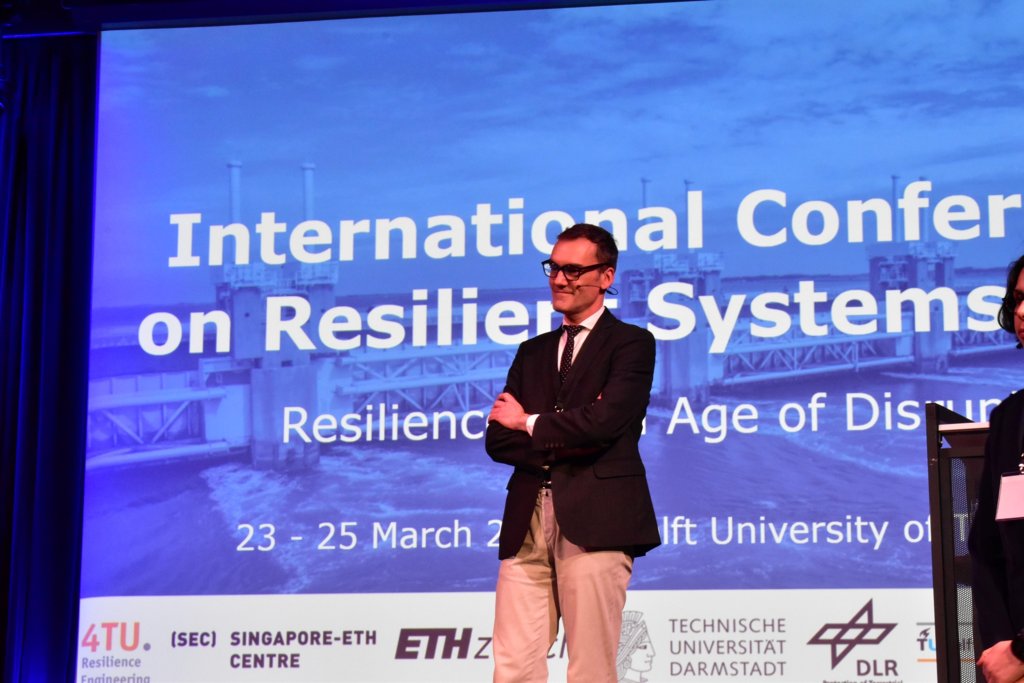
Drawing on his background in civil engineering, Georgios Tsionis reflected on the venue of the conference – the TU Delft Aula building – noting its striking reinforced concrete structure. This observation anchored his keynote in the physical reality of the built environment, highlighting its dual role as both a technical system and a lived space.
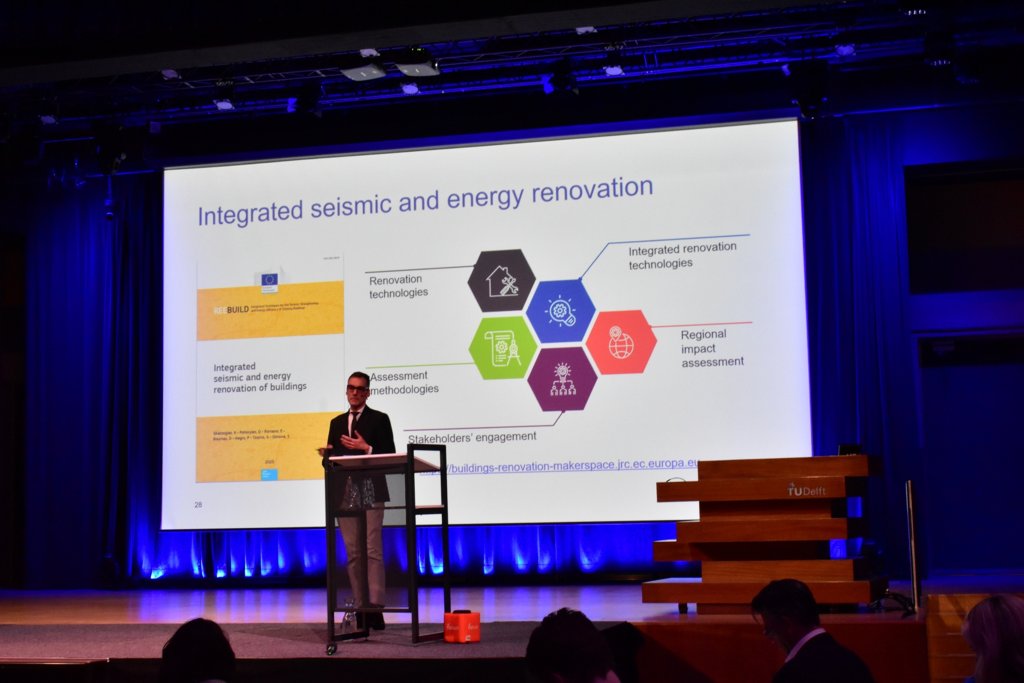
Georgios Tsionis, Deputy Head of Unit ‘Built Environment’ at the Directorate for Societal Resilience and Security within the European Commission Joint Research Centre (JRC), delivered the closing keynote of the conference. His lecture brought together the conference’s central themes - resilience, risk, and vulnerability - placing them within a wider European policy landscape.
Science for policy: anticipating and shaping impact
A central thread of Georgios’s keynote was the JRC’s mission of “science for policy”, which he framed through three key principles: anticipate, integrate, and impact. Since joining the JRC in 2014, he has contributed to its role as a bridge between scientific research and policymaking at the European level.
He emphasised that the JRC provides independent, evidence-based knowledge to support EU policies, ensuring that decisions are grounded in robust science. This involves advising European Commission services, connecting researchers with policymakers, and aligning scientific work with the strategic priorities of the European Commission. Within this framework, resilience is not treated as a standalone objective but as a cross-cutting priority embedded across multiple policy domains.
The built environment as a critical ecosystem
Georgios then turned to the built environment, which is central to everyday life. His work focuses on buildings and, increasingly, transport infrastructure - systems that shape how people live, move, and interact. As he noted, Europeans spend approximately 85–90% of their time indoors, underscoring the profound influence of the built environment on health, well-being, and productivity.
This importance is reflected in the construction sector’s scale. It contributes significantly to GDP and employment across the European Union, yet it also places considerable pressure on natural resources. The construction sector consumes large quantities of raw materials, including critical resources whose future availability is uncertain. At the same time, it accounts for around 40% of the EU’s total energy consumption and contributes to a substantial share of greenhouse gas emissions. Construction and demolition waste is another concern, representing approximately 37.5% of total EU waste in 2020.
A further challenge lies in the ageing building stock. With around 80% of EU buildings constructed before 1990, many suffer from poor energy performance and increased vulnerability to environmental and other hazards. Georgios highlighted the need to address these issues while balancing affordability and the preservation of cultural heritage, particularly in the case of historic buildings.
Infrastructure, risk, and interconnected systems
Transport infrastructure forms another key component of this ecosystem. Georgios pointed to the Trans-European Transport Network (TEN-T) as a vital framework supporting economic competitiveness and territorial cohesion. Spanning thousands of kilometres of bridges and tunnels, Georgios remarked that, if connected consecutively, these bridges would stretch from Brussels to Rome. Its significant overlap with military transport routes further underscores the network’s strategic importance, reinforcing the need to understand infrastructure resilience as part of a wider, interconnected system.
The discussion of infrastructure led naturally into the question of risk. Georgios highlighted earthquakes as one of the most consequential hazards globally, both in terms of human impact and economic cost. However, his broader argument was that the nature of risk is evolving. Climate change, resource constraints, and increasing system interdependencies are reshaping the challenges faced by the built environment, requiring more integrated and forward-looking approaches. Georgios referenced key state-of-play documents outlining risks, such as the European Climate Risk Assessment (2024), and Cross-border and emerging risks in Europe (2024).
Policy directions and emerging priorities
These shifts are reflected in a growing body of European policy initiatives, such as The Renovation Wave, the European Affordable Housing Plan (2025) - and its associated Staff Working Document – SWD (2025), and the European Strategy for Housing Construction (2025). Taken together, these signal a move towards more holistic policymaking, where resilience, sustainability, and social concerns - particularly housing affordability and resilience - are addressed in tandem.
Technical guidance on adapting buildings to climate change (e.g. EU-level technical guidance on adapting buildings to climate change (2023)), alongside research into issues such as the degrading of building materials over time (e.g. Impact of climate change on the corrosion of the European reinforced concrete building stock (2024)), demonstrates how scientific knowledge is being translated into practical tools for implementation. Georgios also highlighted the importance of standards, highlighting the Eurocodes - which provide a common framework for structural design across Europe, covering areas such as fire safety and seismic performance. He noted that a second generation of these codes, that will support innovation and will consider the future climate hazards, is soon to be released.
Complementing these technical frameworks, initiatives such as the New European Bauhaus introduce a broader perspective, integrating sustainability with design quality and societal values. This reflects an increasing recognition that resilience is not only a technical challenge, but also a cultural and social one.
Concluding reflections
Georgios’s keynote delivered a clear and timely message: resilience in the built environment cannot be addressed in isolation. It must be integrated across disciplines, sectors, and policy domains, and supported by strong linkages between scientific research and decision-making. He emphasized that policymakers seek evidence-based guidance, underscoring the importance of involving them from the earliest stages of research, while also being transparent about the time limitations of scientific knowledge. He concluded with a pragmatic reminder:
“Sometimes simple solutions are good enough for practical applications.”
By framing the built environment as both a source of risk and an opportunity for transformation, he highlighted its central role in shaping a more sustainable and resilient future for Europe, and beyond.
Relevant links
· Cross-border and emerging risks in Europe (2024)
· European Climate Risk Assessment report (2024).
· The European Affordable Housing Plan (2025).
· Staff Working Document (SWD, 2025)
· Impact of climate change on the corrosion of the European reinforced concrete building stock (2024)
· Eurocodes: standards for structural design
· Integrated seismic and energy renovation of buildings (2023)
· Engineering Research Infrastructures for European Synergies (ERIES)
· Trans-European Transport Network (TEN-T)
· EU Disaster Risk Reduction Goals (2023)
· European Strategy for Housing Construction (2025).
· EU-level technical guidance on adapting buildings to climate change (2023).
· The New European Bauhaus (NEB)
· NEB self-assessment method and tool (2024)
Author: Anja van der Watt
Editor: Nienke D. Nijenhuis