



Goods arrive from the far East by immense cargo ships. But once unloaded in Rotterdam or Amsterdam, their journey into mainland Europe often depends on inland waterways like the Twente Canal, a critical yet vulnerable gateway. In 2022, when the Netherlands suffered from a major drought event, this vulnerability was exposed. The water level dropped so low that inland waterway cargo ships could no longer sail.
In response, a consortium* consisting of industrial partners, ports and logistics, governmental organisations, and academia developed a digital twin for resilient multimodal corridors on the Twente Canal.
Resilient multimodal corridors in this context are transport networks that can continue operating effectively even during disruptions such as droughts, floods, infrastructure failures, or supply chain problems. ‘Multimodal’ means that different transport modes, such as inland shipping, trucks, and rail, work together as one connected logistics system. ‘Resilient’ refers to the ability to adapt, recover, and continue transporting goods when conditions change unexpectedly.
In the Twente Canal context specifically, resilience means ensuring that industries and logistics companies can continue moving goods efficiently, even during periods of extreme low water levels caused by climate change. This is precisely what the project aimed to achieve.
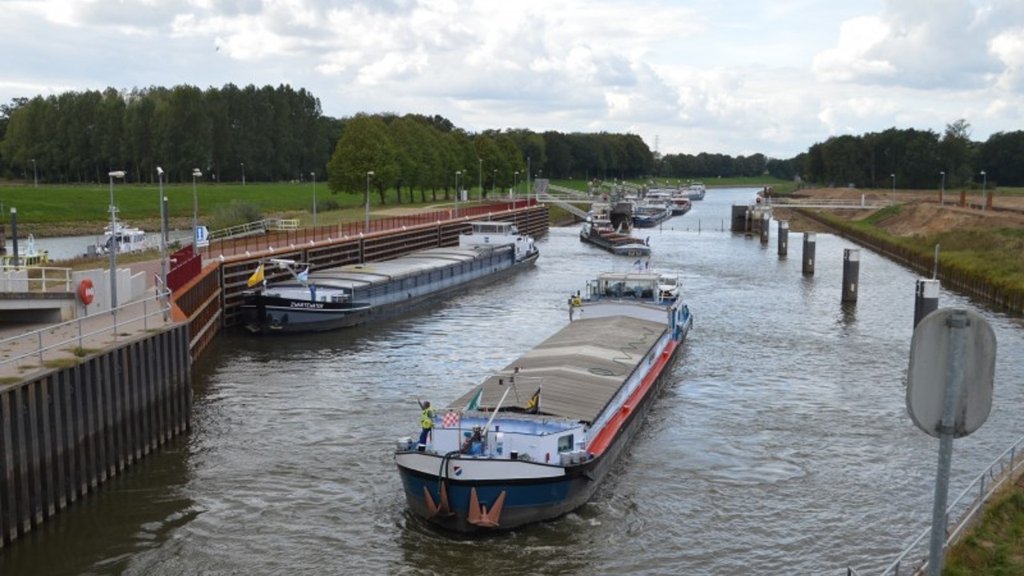
Cargo ships waiting at the lock in Eefde, 2018. Photo by Anne-Ruth Scheijgrond.
Yongjian (Tommy) Tao, who obtained his EngD degree in May 2026 for this project, began by interviewing consortium members to identify operational challenges in the Twente Canal corridor, particularly during extreme weather conditions such as droughts and low water levels.
Based on these discussions, Tommy translated stakeholder needs into practical ‘use cases’ for the digital twin platform. The high-priority use cases included: real-time water level and weather monitoring, vessel and infrastructure monitoring, corridor-wide situation awareness, and cargo demand-vessel availability coordination. These use cases were prioritised because stakeholders considered them the most useful for improving daily decision-making, logistics planning, and resilience during disruptions.
A digital twin to support an interconnected logistics system
As Tommy explains, the digital twin’s power lies in its ability to unify disparate data, such as water levels, weather forecasts, vessel traffic, and infrastructure conditions, into a single, shared platform for stakeholders. A digital twin helps stakeholders gain a shared overview of the corridor by combining different types of information into one platform. During disruptive events like droughts or lock failures, the platform can support earlier and better-informed decisions. For example, companies can adjust cargo loads or reschedule transport. They can also switch modes – use trucks and/or rail – or coordinate alternative routes before problems escalate.
In periods of low water levels, the platform’s cargo–vessel matching function can also support more efficient use of return-empty vessels, reducing unnecessary lock operations at Eefde and helping to maintain water levels within the Twente Canal system. In addition, the platform can support the coordination of shuttle vessels and smaller ships that are better suited to navigate shallow water conditions on the IJssel River. Rather than reacting only after disruptions occur, the digital twin supports proactive planning, resource coordination, and collaboration between organisations across the corridor.
Farmers and the food supply chain
The drought’s ripple effects extended beyond industrial logistics. Farmers, too, faced disruptions, as animal feed transport relies heavily on these waterways. Inland shipping is an efficient and sustainable way to transport large volumes of goods to farms, production facilities, and regional industries. During low water periods, vessels cannot carry full loads, which increases transportation costs and may delay deliveries. In some cases, transport must temporarily shift from vessels to trucks, increasing both operational costs and emissions. These disruptions can affect production planning, inventory management, and the reliability of food and feed supply chains.
In the study, agricultural stakeholders emphasized the importance of reliable water level information, real-time communication, and flexible logistics planning. Without reliable water level data or real-time communication, companies struggle to plan transport schedules or coordinate vessel capacity. They highlighted the need for better visibility of future corridor conditions so that companies can prepare transport schedules, coordinate available vessel capacity, and react earlier to disruptions. Through the platform, companies can share their expected transport demand, cargo information, destinations, and vessel requirements for the coming days or weeks. This helps different parties coordinate transport earlier and respond more quickly when water levels become critical.
Unnoticed impacts of uncertainty
Tommy discovered that the level of uncertainty created throughout the logistics chain often goes unnoticed. During low water periods, companies not only face higher transport costs, but also difficulties in planning production, storage, and deliveries due to limited visibility of future corridor conditions. Low water levels can also lead to more empty return trips, increased lock operations, and greater pressure on road transport when cargo shifts from vessels to trucks. These indirect effects influence not only logistics efficiency, but also infrastructure usage, emissions, and regional supply chain stability.
Beyond the Twente Canal: spill-over effects for the Netherlands
The project’s insights didn’t stop at the Twente Canal. Other ports and waterway authorities facing similar challenges have taken notice. The project has also attracted interest from other ports, waterway authorities, and regional initiatives facing similar climate-related logistics challenges. This suggests that the lessons learned from the Twente Canal may also be relevant for other inland waterway corridors in the Netherlands.
Tommy emphasizes that resilience is as much an organizational and collaborative challenge as a technical one. Building resilience requires different stakeholders – governments, companies, infrastructure operators, and researchers – to share information and work together.
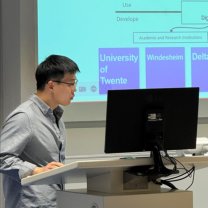
Rather than developing technology in isolation, the digital twin was designed together with stakeholders based on practical operational needs. For colleagues working in areas such as infrastructure resilience, climate adaptation, agriculture, or smart mobility, the project demonstrates how digital twins can support cross-domain collaboration and improve decision-making under uncertainty.
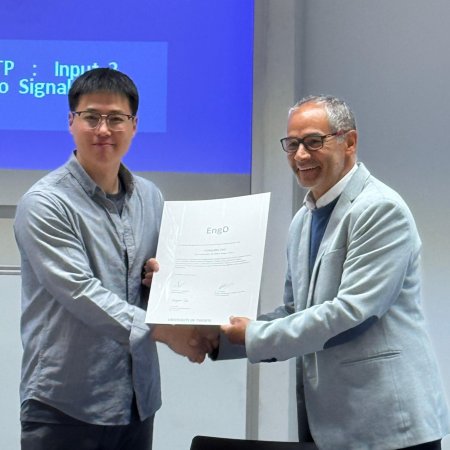
Yongjian (Tommy) Tao receives his EngD diploma from dr. Seirgei Miller, Programme Director for Civil Engineering's Engineering Doctorate (EngD) programme
* The consortium consists of Riwald, Nobian, For Farmers, Van Merksteijn, CTT, Peterson, Port of Twente, Port of Zwolle, Rijkswaterstaat, Provincie Overijssel, Gemeente Enschede, Deltares, Windesheim, University of Twente. This project received a small fund from 4TU.Resilience Engineering, under the 4TU.DeSIRE programme, which ran until 2023.
Text by Yongjian (Tommy) Tao, edited by Nienke D. Nijenhuis. Picture credits: Ries Bosch on Unsplash