



Lisa Schipper’s keynote lecture challenges the conventional narrative that climate adaptation is universally beneficial. While adaptation or the adjustments that we put in place to reduce harm from climate impacts is acknowledged, it doesn’t happen at the speed that is necessary. The planning for adaptation is there, governments take it seriously, the number of adaptation projects is growing. The pressing question is: Does adaptation really do something?
Poorly designed or inequitable adaptation efforts can inadvertently increase vulnerability, highlights Lisa Schipper, full professor of Development Geography at the University of Bonn. This phenomenon, known as maladaptation, occurs when solutions shift risks onto others, redistribute harm, or create new problems. Examples include infrastructure projects that protect one community while displacing others or institutional responses that prioritise short-term gains over long-term equity. Lisa underscores that adaptation is deeply embedded in power structures, and without deliberate reflection on justice, even well-intentioned actions can perpetuate harm.
Adaptation has limits – and those limits are already being reached
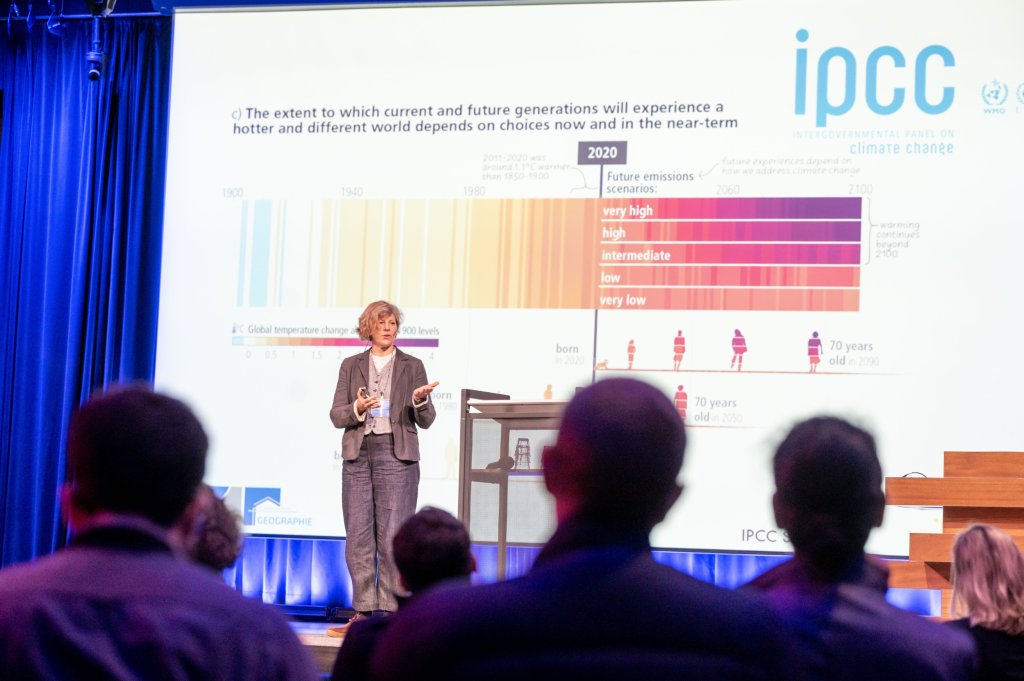
In her keynote, Lisa Schipper draws on the IPCC’s Sixth Assessment Report (AR6) to stress that adaptation alone cannot prevent all climate-induced losses and damages. Above 1.5°C of global warming, some natural systems and human communities will face conditions beyond their capacity to adapt. For instance, small island nations and glacier-dependent regions risk losing access to freshwater, while agricultural systems may collapse in areas where staple crops can no longer thrive. Lisa’s framing of the “Human Climate Niche” – the historically stable range of temperatures where human civilisation has flourished – illustrates that over a third of the global population could be pushed outside this niche by 2100 under current policies. This reality demands a shift from incremental fixes to transformative change.
Lisa urges us when we assess the adaptation outcome to ask questions like: who should benefit or who is adversely affected? What should the purpose of the original initiative be? And what should the intervention be assessed against?
Adaptation is a social and political process – not a technical fix
The distinction between “Adaptation”, capitalised, as a systemic rethinking of development, and “adaptation”, lowercase, as piecemeal projects, is notable, as Lisa Schipper explains during her keynote. The latter often fails to address the root causes of vulnerability, such as poverty, inequality, or colonial legacies. Lisa critiques the assumption that adaptation can be achieved within existing unjust systems, arguing that development deficits – the structural inequalities in access to resources, power, and opportunities – are inseparable from adaptation challenges. She points to the "Locally-led Adaptation" model as a promising alternative, which devolves decision-making to affected communities, centres their priorities, and addresses structural inequalities through flexible funding and collaborative action. However, this requires rethinking power dynamics in climate finance and project design.
Epistemic injustice: Who gets to define adaptation?
A striking theme is the epistemic injustice embedded in climate adaptation research and policy. The lecture reveals stark imbalances in whose knowledge counts: the Reuters 1000 list of influential climate scientists is dominated by men from the Global North, with only 111 scholars from the Global South (88 of them from China) and none from African institutions outside South Africa. This reflects broader systemic barriers, including funding inequities – 78% of climate research funding flows to European and North American institutions – and the coloniality of knowledge production. Lisa argues that the dominance of positivist, model-driven approaches silences alternative worldviews, particularly Indigenous and local knowledge systems. This not only undermines the legitimacy of adaptation strategies but also perpetuates injustice by framing vulnerability as a technical problem rather than a symptom of deeper inequities.
The path forward: Rethinking adaptation as transformation
Concluding, Lisa Schipper says that adaptation must be reimagined as a process of transformation, not just risk management. This means decoupling adaptation from neoliberal, project-based frameworks and instead embedding it within broader struggles for justice. She calls for acknowledging that adaptation, as currently practiced, often normalises vulnerability rather than addressing its roots.
The lecture’s provocative title “Resilience, but for whom and at what cost?” serves as a reminder that resilience-building must centre the most marginalised, challenge systemic injustices, and prioritise long-term equity over short-term solutions. Ultimately, Lisa’s work urges a paradigm shift: adaptation should not merely respond to climate impacts but actively transform the conditions that create vulnerability in the first place.


Photos: Erno Wientjens.