



On 28 May 2026, the 4TU.Health Centre held its first 4TU.Health Event at the Omnia Conference Centre in Wageningen. Over 150 participants, including researchers, clinicians, entrepreneurs, policymakers and healthcare professionals, gathered around one shared goal: accelerating the responsible translation of technological innovation into everyday care practice. The event was fully booked, a signal in itself of the urgency felt across the field.
Looking back and strategy 2026–2030
Chair Noortje Bax opened the day with a reflection on six years of 4TU.Health actively invited participants to help shape the network strategy for 2026–2030. The tone was not that of a conference where knowledge is transferred, but of a working session where direction is set. Participants were explicitly asked: What should the priorities be in the years ahead?
The thread running through the entire day: implementing technology in healthcare is fundamentally different from simply installing it. The reality of the hospital is shaped by complex forces, professional routines, funding structures, regulation and human behaviour, each of which requires its own approach. Any innovation that ignores this will sooner or later come unstuck.
Nine sessions, one message
Morning and afternoon sessions covered nine themes: AI in healthcare, remote monitoring (RECENTRE), the care pathway as the missing link, support structures for HealthTech innovators, the Creathon as a working format, imaging, bio-engineering, implementation & scaling, and the role of technology for the healthcare professional.
Time and again, the same finding emerged: it is not the technology itself, but the conditions for adoption, organisational, financial and regulatory, that determine whether innovation truly takes hold. The AI session showed that broad application promises only acquire value when strategic, ethical and practical conditions are built in from the outset, not retrofitted afterwards. The implementation & scaling session illustrated, through the cases of Cue2Walk and smartQare, how the path from pilot to structural solution is blocked by fragmented responsibilities and misaligned reimbursement models.
„Everything is possible, as long as you start with the problem and the question, and resist
the urge to jump straight to the solution.”
Panel discussion: structural change required
The day closed with a plenary discussion involving representatives from VWS, FME, NWO, the Collaborative Top Clinical Hospitals (Samenwerkende Topklinische Ziekenhuizen) and the Disciplinary Council for Biomedical Technology. The central metaphor that dominated the discussion: the Netherlands has enough pilots, but too few ‘aeroplanes’. The challenge is not a shortage of innovation, but a shortage of the right conditions to move from proof of concept to structural implementation.
The panel unanimously called for greater risk appetite among investors, stronger alignment between healthcare providers and technology developers, and a rethinking of experimental reimbursement models via the NZa as a potential lever to create the financial and regulatory space that meaningful innovation requires.
Conclusions and recommendations
Five insights crystallised from the sessions, discussions and corridor conversations that ran through the entire day:
- Resistance is not the enemy. When healthcare professionals push back on innovation, this is rarely opposition for its own sake: it is a signal that the innovation needs to fit better within existing reality.
- Start on the shop floor. Developments should begin by shadowing a clinical department, asking questions, and verifying that data reflects day-to-day reality rather than idealised models.
- Integral problems require integral solutions. Fragmented, technically refined partial solutions are insufficient for lasting change in healthcare.
- Cross-boundary collaboration is not a luxury. Collaborating across institutions, disciplines and even regulatory boundaries is a necessary precondition — not an option.
- Education must change. Engineers working at the intersection of technology and care can only be trained if clinical practice and academic education are far more closely interwoven than they currently are.
The day in one image
The illustration below, created live during the event, captures the breadth and energy of the day: from the opening plenary through the parallel sessions to the closing panel discussion. It reflects the themes, ideas and connections that surfaced across the 4TU.Health event ‘Bridging Health and Engineering’. View all the pictures of the event here.
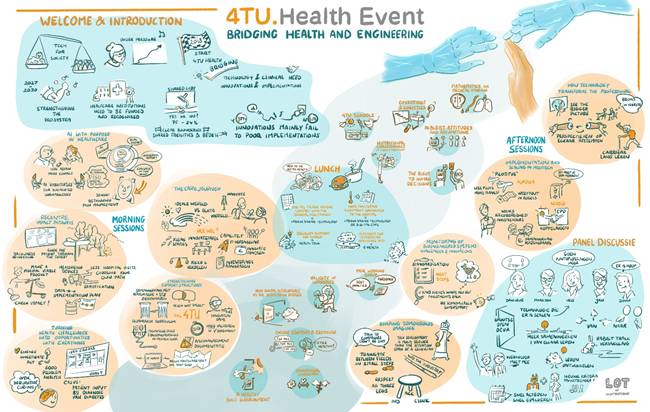
Illustration created by LOT Illustrations.
About 4TU.Health
The 4TU.Health Centre brings together TU Delft, TU Eindhoven, the University of Twente and Wageningen University & Research to develop advanced technology for patient-centred healthcare innovation. By combining technological innovation with insights from the social and medical sciences, the four technical universities contribute to structural solutions for the challenges facing healthcare, with the patient’s voice at the heart of a changing care environment.
Would you like to stay up to date with 4TU.Health developments, news and events? Follow us on LinkedIn, our website or get in touch with us.