



What if a new technology could deliver life-saving drugs directly to the brain, but the process relies on new experimental in vitro and in silico models instead of traditional testing pipelines? Would you feel hopeful and excited? Or uneasy and hesitant?
As part of my work within the NAP4DIVE[1] project, which develops new approach methodologies (NAMs) including advanced in vitro and in silico models for biomedical research, I explore the ethical and societal implications of these new and emerging technologies. In my research, I use scenarios to engage project stakeholders with possible futures related to these novel technologies. During this process, I noticed something striking: people rarely respond to emerging technologies in a detached, purely rational way. Instead, they react emotionally, expressing excitement about the new technology or voicing their concerns about it.
Yet, these emotional responses are often treated as ‘problematic’. In many debates about new and emerging technologies, emotions are seen as irrational and misguided when it comes to a rational, facts-based decision-making process. The Emotional Deliberation Approach by Sabine Roeser challenges this view by considering the constructive role emotions can play in participatory decision-making. Rather than dismissing emotions, this approach sees them as valuable, whereby emotions can point to what people care about and thus reveal underlying values (Roeser, 2017). This insight made me rethink my own work on scenarios. I began to see emotions as a possible starting point for engagement with stakeholders through scenarios. Here, I argue that scenarios can function as a form of ‘techno-art’ (Roeser, 2016; Steinert & Roeser, 2019) that enables emotional deliberation as well as supports normative reflection in contexts of Responsible Research and Innovation (RRI).
Scenarios beyond foresight
Scenarios are widely used and understood as descriptive, anticipatory foresight tools to explore possible futures. In the context of the NAP4DIVE project, scenarios might describe a future in which novel in vitro and in silico models replace methods of animal testing in drug development for brain diseases.
Scenarios are broadly characterised as being future-oriented as well as plausible and possible, and are presented in the form of a story or narrative description (Spaniol & Rowland, 2019). Scenarios can be especially relevant in contexts of New and Emerging Science and Technology (NEST), where ethical and epistemic uncertainty is high. Hereby, they can offer a way to make uncertain futures more tangible.
However, their normative potential is often overlooked. I propose that scenarios can not only function as tools to anticipate futures, but also as normative tools by helping us reflect on what kind of future with technology we want.
Scenarios as ‘techno-art’
Roeser introduces the concept of ‘techno-art’ in the context of enhancing public deliberation and decision-making, which can lead to (morally) better technological innovations (Roeser, 2016). ‘Techno-art’ is defined as: “visual art (...) and literature that reflect on and engage with different kinds of technologies and their promises as well as their potentially risky and controversial aspects” (Steinert & Roeser, 2019, p. 98). Roeser specifically mentions ‘techno-literature’ as a major category of techno-art; however, she does not explicitly include scenarios in this category (Roeser et al., 2018).
I contend that scenarios can be understood as a form of narrative techno-art, as techno-literature, if you will. Like art, scenarios can evoke emotional and moral responses. And like literature, they tell tangible stories about possible futures.
From emotions to values to reflection – and back again
What makes scenarios a powerful tool for stakeholder engagement is the way they can structure this engagement. By constructing it as an iterative process, scenarios can evolve alongside the development of technology.
First, scenarios make possible futures tangible. Instead of abstract scientific or philosophical discussions, stakeholders are directly presented with concrete narratives about possible futures, which invites an emotional response.
Second, drawing on the emotional deliberation approach, these emotions can reveal underlying values (Roeser, 2017). For example, feelings of hope about new brain-disease treatment possibilities can reflect values such as well-being. At the same time, feelings of uneasiness about new experimental models may point to underlying concerns about safety. This illustrates how emotions can elicit what is at stake for stakeholders in evaluating such technologies.
Third, this opens up space for reflection. Stakeholders can ask themselves, “Why do I feel this way? What kind of future do I actually want?” In doing so, emotions can become an object of reflection rather than an immediate response. Stakeholders can hereby explore whether these values and emotions should guide future developments.
Finally, scenarios can stimulate imagination and invite co-creation. They encourage stakeholders to imagine alternative futures and to consider how emerging technologies might affect what they value. Stakeholders can then modify existing scenarios or create their own, exploring different futures and integrating their values into them.
There are two ways in which stakeholders can interact with scenarios. On the one hand, they can engage with scenarios created by others, for example, by developers of the technology. This can already prompt reflection and discussion between different stakeholders. On the other hand, stakeholders can actively create their own scenarios. This requires them to imagine futures themselves, reflect on their values, and articulate them in narrative form. This enables a deeper level of engagement, as stakeholders move from reacting to actively shaping possible futures.
This process is not linear, but iterative (see Figure 1). Scenarios can be revisited, revised and reimagined, which allows for a continuous reflection as innovative technologies evolve.
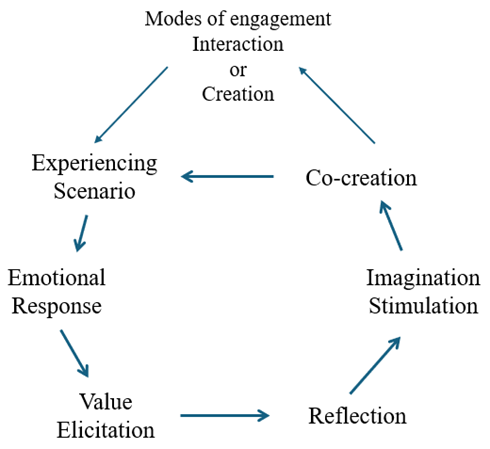
Figure 1: The iterative process of using scenarios for stakeholder engagement.
Conclusion
Instead of trying to remove emotions from debates on New and Emerging Science and Technology (NEST), we should allow for and create ways in which emotions can essentially guide us. Scenarios, understood as a form of ‘techno-art’, i.e. ‘techno-literature’, can enable such emotional-moral reflection about possible futures influenced by emerging technologies. By using emotions as a starting point, scenarios can elicit underlying values, create space for reflection, stimulate imagination, and allow for an overall meaningful way of engagement with stakeholders within Responsible Research and Innovation (RRI).
References
Roeser, S. (2016). How Art Can Contribute to Ethical Reflection on Risky Technologies. In L. Janssens (Ed.), The Art of Ethics in the Information Society (pp. 127–131). Amsterdam University Press. https://doi.org/10.5117/9789462984493
Roeser, S. (2017). Risk, technology, and moral emotions. Taylor & Francis. https://doi.org/10.4324/9781315627809
Roeser, S., Alfano, V., & Nevejan, C. (2018). The Role of Art in Emotional-Moral Reflection on Risky and Controversial Technologies: The Case of BNCI. Ethical Theory and Moral Practice, 21(2), 275–289. https://doi.org/10.1007/s10677-018-9878-6
Spaniol, M. J., & Rowland, N. J. (2019). Defining scenario. FUTURES & FORESIGHT SCIENCE, 1(1). https://doi.org/10.1002/ffo2.3
Steinert, S., & Roeser, S. (2019). Passion for the Art of Morally Responsible Technology Development. Royal Institute of Philosophy Supplement, 85, 87–109. https://doi.org/10.1017/S135824611800070X
Author Bio
Vivian Brunsberg is a PhD candidate at Eindhoven University of Technology, working on the ethics of emerging biomedical technologies in the EU-funded NAP4DIVE project. In parts of her research, she explores how scenario planning can support stakeholder engagement and ethical reflection on technological futures.