



We like to think of technology as our signature trade: we are the technological animal, whether due to our inferior bodies or superior intellect. Technology is designed by us and for us. It is not surprising, then, that we take humans to be the prime concern of technology ethics; we are its impact makers and impact takers. Calling a technology ‘human-centred’ is therefore meant as something good: it signals attentiveness to human values and needs.
Yet the equation of human-centred and good sits increasingly uneasily with the growing impact of our technologies on the more-than-human world, not least our fellow animals.
Our technologies affect animals in countless ways: positively and negatively, directly and indirectly. From GPS collars that track companion animals to tasers used in factory farming; from wildlife monitoring systems to ever more efficient hunting gear; from innovations that render animal experiments obsolete to the testing of new technologies on animals. The impact of technology on animals is ubiquitous. And yet remains a huge blind spot in technology ethics.
The good news is that the conceptual tools to widen the moral scope of technology ethics are already there. We ‘simply’ have to connect the dots.
Dot 1: Moral considerability of animals in design
That the impact of our technologies exceeds human society is hard to miss in the face of climate change and biodiversity loss. I single out animals here because we have a special moral relationship with them.
As sentient beings, animals have the capacity to experience positive states (pleasure, comfort, joy) as well as negatives ones (pain, fear, stress). Because things can genuinely go better or worse for them, they have interests—at the very least, an interest in not suffering. This is the basis of their moral considerability: we owe their interests our concern, not as a means to human ends, but because those interests matter in their own right. And because those interests can be set back by our actions, animals are also moral patients: beings who can be wronged by what we do.
This is not a fringe position. It is the mainstream view in animal ethics, and increasingly reflected in law and policy. Animal well-being has become the standard concept to speak about an animal’s state of being well. This encompasses both the absence of negative states like pain and distress, and the presence of positive ones associated with their natural behaviour. In this sense, animal wellbeing mirrors human wellbeing, referring to the overall quality of life as experienced by the one leading it.
There are many ways in which our actions affect animal lives, and technology is one way. The impact of technology on animals is increasingly recognised (Bos et al., 2018; Szymanski et al., 2021; Umbrello, 2021). Attention typically focuses on technologies that affect animals directly: those used in factory farming, deployed in animal habitats, or involved in research practices. Yet technologies also affect animals indirectly, by mediating human–animal relations and transforming the ecosystems animals inhabit (Bossert & Coeckelbergh, 2024). This makes animals moral patients with respect to our technologies: beings whose interests are vulnerable to our design choices, and who are therefore owed consideration in how those choices are made.
Yet animal well-being remains a big blind spot in technology development. When animals enter the process at all—as in farming technologies—they typically appear as resources to be optimised, not as stakeholders to be considered. Their interests usually enter the design process only insofar as compliance requirements impose limits on their use (e.g. how to optimise productivity while meeting minimal welfare standards). As a result, consideration tends to be narrow (focused on preventing the worst harms) and limited to specific domains, while the broader and indirect effects of technology on animals remain largely unaddressed.
A simple way to see the limitation is to ask: What would change if animal interests were taken seriously from the outset of design? Many familiar technologies would look very different, and some might not be developed at all.
At present, however, animals largely remain impact-takers ‘by design’: systematically affected by technologies, yet structurally excluded from shaping them. Taking the interests of animals seriously calls for a recalibration in the development of technology.
Dot 2: Value-sensitive design
Technologies can be seen as materialised possibilities: they enable and encourage certain ways of being and doing. To an important extent, these possibilities are shaped in the design process. Before materialised possibilities, technologies are thus also materialised choices of designers. This makes design a crucial and potentially effective site of ethical investigation: what forms of being and doing do particular design choices enable?
Choices about whom the technology seeks to support and what for are not neutral; they involve, implicitly or explicitly, values-based decisions (Miller, 2020; Van de Poel, 2021). Recognising this value-ladenness of design choices gave rise to design approaches that seek to proactively ponder the ethical implications of technological design.
One well-known approach to this is value-sensitive design (VSD). In a nutshell, VSD is a process-focused methodology aimed at investigating which values are affected by a prospective technology and how. Here, values can be understood as tracing back to morally relevant interests: interests we have reason to take into account on moral grounds rather than, for example, commercial ones. By feeding back this reflection into the design process, it ‘sensitises’ design to ethical considerations.
In practice, the values considered in VSD are human values, and the stakeholders consulted are usually human as well. Yet nothing in its basic structure restricts it to that scope. On the contrary, its framework appears well-suited to accommodate animal interests and to broaden ethical reflection towards more-than-human wellbeing, precisely because it aims to map not only who will use a technology but also who is likely to be affected by its use. Removing its anthropocentric default, this would immediately bring into view animals as impact-takers of technology.
A recurring critique, on the other hand, is that VSD lacks normative direction: it needs a substantive ethical theory to determine what design should ultimately aim at. Enter the capabilities approach.
Dot 2: Capabilities approach
Starting from the premise that technologies significantly enable human action, several authors have proposed combining VSD with the capabilities approach (CA) (Oosterlaken, 2012; Jacobs, 2020). In brief, CA holds that evaluations of wellbeing, justice, and development should focus on what individuals are effectively able to do and be. These “beings and doings”, or capabilities, are the freedoms a just society ought to protect and promote.
Combined with VSD, this yields capability-sensitive design (CSD). CSD – the last acronym I introduce here, I promise – adopts VSD’s process but anchors it normatively in the promotion of capabilities. It asks: what does a given design enable, for whom, and how does it expand or constrain their opportunities to flourish?
In practice, the answer is typically framed in terms of human capabilities. This is not a flaw in CSD, but a reflection of how it has so far been applied; a limitation that often remains implicit rather than defended as a normative choice. But if capabilities function as its evaluative metric, the framework is, in principle, extendable to any being for whom things can go better or worse.
The resources for such an expansion are already present within the capabilities tradition itself. Martha Nussbaum (2023), one of the founders of CA, argues that capabilities provide the most promising framework for understanding and advancing animal wellbeing. Just as she proposed a list of capabilities crucial for human flourishing, Nussbaum develops a list of capabilities that correspond closely to animal flourishing.
This paves the way for extending the approach of CSD beyond human capabilities and for using it as a way to take the interests of animals into account during the design process. Doing so would not require reinventing the CSD framework, but making explicit what its own normative logic permits: a design practice attentive to capabilities, whether human or more-than-human.
The missing link: Design for more-than-human wellbeing
Connecting the dots – the impact of technology on animals, their moral considerability, design approaches attentive to values and capabilities, and a capabilities-oriented account of animal wellbeing – begs drawing the missing link: a design practice attentive to more-than-human wellbeing. If the aim of ethical design is to anticipate what technologies may do and to steer, as far as possible, away from harm and towards flourishing, then our responsibility goes beyond human wellbeing.
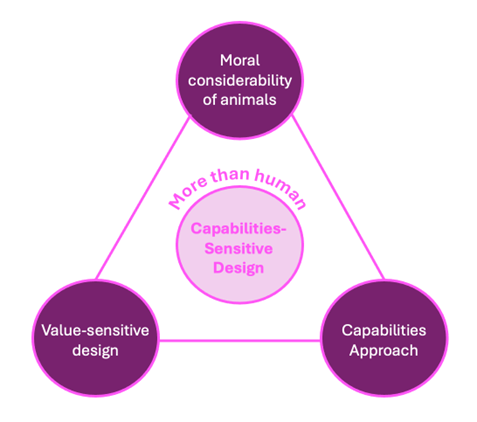
Such a “design for more-than-human wellbeing” involves some challenges — that is, beyond the challenge of persuading others that this responsibility exists at all. I set that foundational debate aside here and instead highlight three practical-ethical quandaries that await us beyond that point.
The first concerns scope. Once animals enter the picture of CSD, the question becomes: which animals? Sentience offers a relatively uncontroversial eligibility threshold. But even among sentient animals, we still face the same contextual question that arises with human stakeholders: which of them are actually affected by this technology, and how directly? This cannot be settled in the abstract. It requires case-by-case justification, just as it does for human stakeholders. The crucial move, however, is to change the default: once we acknowledge animals as stakeholders in principle, excluding them is no longer a neutral starting point but a boundary decision that calls for defence.
The second challenge is conflict. Expanding the circle of concern increases the likelihood of tensions in the complex web of interests. Beyond tensions among human stakeholders, including animal wellbeing adds an extra dimension of possible conflict: between human and animal capabilities, and among different animals. This certainly does not make CSD any easier. Some conflicts may soften once we shift from short-term preferences to capabilities as conditions for flourishing, but others will not.
Beneath these practical tensions lies a harder normative question that we cannot sidestep: how do we weigh animal wellbeing against human wellbeing when they conflict? And among animals, does the well-being of a chimpanzee count the same as that of a chicken? These questions sit at the core of animal ethics and remain deeply contested. There is no near-term resolution, and perhaps no long-term one either. Yet incorporating animals into CSD at least renders these trade-offs visible and contestable, rather than allowing them to remain obscured by a default.
The third challenge is uncertainty. Like VSD, CSD operates under epistemic constraints: we never have direct access to the well-being we seek to promote. In the case of humans, there is the advantage of shared language, through which interests can be expressed.
In the case of animals, that interpretive task crosses species boundaries, complicating it even more. Still, our empirical understanding of animal well-being has advanced considerably (De Waal, 2016) and can inform design in meaningful ways. Where uncertainty persists, a precautionary stance may be warranted, erring on the side of protecting capabilities and taking our understanding of human capabilities as a proxy.
Upshot
So where do we stand? Once we acknowledge that technologies shape not only human lives but the lives of other animals, the default human-centrism of any approach to technology ethics or responsible innovation can no longer pass as self-evident.
Capabilities-sensitive design (CSD) offers a promising framework for expanding that moral scope. By recognising capabilities as an apt way to think about and foster wellbeing, it can sensitise design not only to human flourishing but to animal interests as well.
I fully recognise that this is demanding. Expanding the circle of moral concern complicates stakeholder analysis, multiplies conflicts, and deepens uncertainty. But these are precisely the kinds of normative challenges an ethically serious design methodology ought to confront. Animals have always been impact-takers of our technologies, and it is up to us, impact-makers, to take moral responsibility for this.
References
- Bos, J. M., Bovenkerk, B., Feindt, P. H., & Van Dam, Y. K. (2018). The quantified animal: precision livestock farming and the ethical implications of objectification. Food Ethics, 2(1), 77-92.
- Bossert, L. N., & Coeckelbergh, M. (2024). From MilkingBots to RoboDolphins: How AI changes human-animal relations and enables alienation towards animals. Humanities and Social Sciences Communications, 11(1), pp. 1-7.
- De Waal, F. (2016). Are we smart enough to know how smart animals are?. WW Norton & Company.
- Jacobs, N. (2020). Capability sensitive design for health and wellbeing technologies. Science and engineering ethics, 26(6), 3363-3391.
- Klenk, M. (2021). How do technological artefacts embody moral values?. Philosophy & Technology, 34(3), 525-544.
- Lawrence, A. B., Vigors, B., & Sandøe, P. (2019). What is so positive about positive animal welfare?—a critical review of the literature. Animals, 9(10), 783.
- Mellor, D. J., & Beausoleil, N. J. (2015). Extending the ‘Five Domains’ model for animal welfare assessment to incorporate positive welfare states. Animal Welfare, 24(3), 241-253.
- Miller, B. (2021). Is technology value-neutral?. Science, Technology, & Human Values, 46(1), 53-80.
- Nussbaum, M. C. (2023). Justice for animals: Our collective responsibility. Simon and Schuster.
- Oosterlaken, I. (2015). Human capabilities in design for values. Handbook of ethics, values, and technological design: sources, theory, values and application domains, 221-250.
- Szymanski, E. A., Smith, R. D., & Calvert, J. (2021). Responsible research and innovation meets multispecies studies: why RRI needs to be a more-than-human exercise. Journal of Responsible Innovation, 8(2), pp. 261-266.
- Umbrello, S. (2021). The ecological turn in design: Adopting a posthumanist ethics to inform value sensitive design. Philosophies, 6(2), 29.
Author bio
Eline de Jong is a PhD candidate in Philosophy and Ethics of Technology at the University of Amsterdam, specialising in the ethics of emerging technologies, particularly quantum technologies. Her research investigates what it means to understand a technology and how ethical engagement is possible in the earliest stages of its development. She publishes on responsible innovation, ethical vision assessment, technosolutionism, and the impact of technology on animals.