


Introduction
Three-dimensional (3D) and four-dimensional (4D) bioprinting, alongside additive manufacturing technologies, are revolutionising diverse fields such as environmental science, automotive design, biology, and medicine. Within healthcare, we are witnessing epochal shifts that were unimaginable just a few decades ago. We are living at the early stage of a new industrial revolution—one in which the industry to be transformed is not a traditional factory of machines, but the human body itself.
Although the industrialisation pipeline of the human body remains in its infancy, it is critical to evaluate what prospective recipients know and understand about the manufacturing processes, structural compositions, and clinical trajectories of bioartificial constructs. Furthermore, given that the foundational cellular building blocks initiating this complex biotechnological process derive directly from human donors (such as stem cell donors or tissue biopsy providers), extending this inquiry to donor perspectives is equally essential. Because clinical trials worldwide are currently limited in scale, a large-scale quantitative survey was considered premature. Instead, an in-depth qualitative empirical design was implemented with a selected sample of patients and donors who had directly navigated cell therapy, organ transplantation, and regenerative medicine environments.
This research explores how individuals conceptualise the convergence of biological materials and engineering technologies, probing the delicate boundary between natural human biology and manufactured biological artefacts. By analysing experiential narratives, policy makers can better anticipate public acceptance, identify structural gaps in technical communication, and develop robust ethical recommendations.
Patient and Donor Awareness
A 2025 qualitative pilot survey conducted at Ca' Foncello Hospital (Italy) revealed that stem cell patients and donors possessed limited prior knowledge concerning bioprinting and bioartificial tissue engineering. Most participants showed awareness with traditional organ donation and basic stem cell therapies, but lacked technical comprehension regarding how living cells are combined with bio-inks, hydrogels, and scaffolds to generate functional three-dimensional organs.
Despite this initial information gap, respondents overwhelmingly viewed bioartificial constructs as a highly promising solution to mitigate chronic donor organ shortages and dramatically improve patient quality of life. Participants expressed profound optimism that bioartificial technology could eliminate the agonising waitlists that currently characterise end-stage organ failure. Furthermore, patients highlighted the emotional relief associated with the potential reduction of graft-versus-host disease and transplant rejection, recognising that personalised bioartificial constructs built from autologous or matched stem cells could offer superior biocompatibility.
Demand for Clear Information and Ethical Recommendations
Alongside strong enthusiasm, participants voiced notable concerns regarding potential ethical misuses, commercial exploitation, and safety uncertainties inherent in bioartificial manufacturing. Respondents emphasised the imperative for transparent, accessible, and structured technical communication delivered directly by multidisciplinary clinical teams to facilitate genuine, autonomous informed consent. Specifically, participants requested detailed, demystified information clarifying the complete multi-stage bioprinting pipeline.
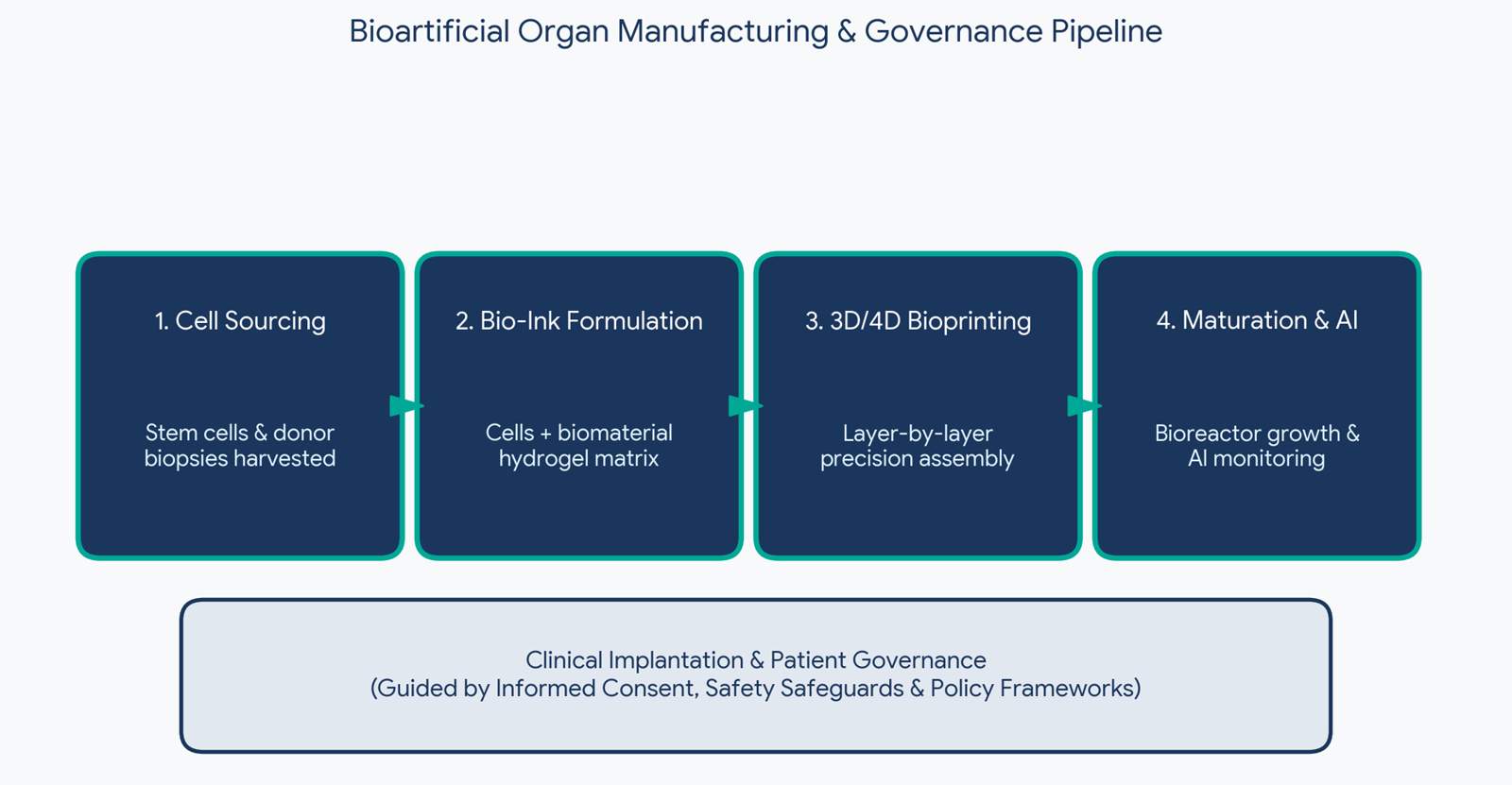
As illustrated in Figure 1 above, this complex multi-stage pipeline spans cell sourcing, bio-ink formulation, bioprinting execution, construct maturation, bio-ink safety validation, and overall process reliability. Regarding clinical transplantation, while participants expressed optimism, they advocated restricting early therapeutic application to end-stage or life-limiting conditions where conventional treatment options have been fully exhausted. Patients underscored that informed consent must not be treated as a mere administrative signature, but as an ongoing communicative process that explains potential long-term risks, such as cellular degradation, unexpected immunological reactions, or structural failure.
Hope for End-Stage Treatments
Patients and donors conceptualise bioartificial constructs as life-saving innovations, ranking them among the most crucial future therapeutic options for terminal organ failure and complex tissue restoration. For patients suffering from end-stage renal disease, severe cardiac insufficiency, or liver failure, bioartificial organs represent a beacon of hope that redefines the prognosis of previously fatal conditions.
Donors also expressed a profound sense of purpose, viewing their cellular contributions as foundational elements of a broader regenerative ecosystem.
Strategic Implications for Policy Makers
Informed Consent Models
These preliminary empirical insights highlight the urgent need for expanded qualitative and eventually quantitative investigations to define optimal strategies for technical communication. Ensuring robust informed consent in bioartificial organ transplantation is both critical and uniquely complex due to the multi-layered manufacturing chain involving interdisciplinary stakeholders who do not always interact directly with patients.
Policymakers should establish standardised communication toolkits that bridge the gap between technical language and patient comprehension. Informed consent frameworks must explicitly outline the origin of cellular sources, the composition of synthetic or natural bio-ink polymers, and the potential long-term biological behaviour of bio-printed architectures inside the human body.
Artificial Intelligence Integration and Biomanufacturing Governance
On the manufacturing front, there is an urgent need for transparent regulatory guidelines regarding the deployment of Artificial Intelligence (AI) in construct design, bioprinting execution, and post-implantation functional monitoring. Policy frameworks should demand algorithmic transparency, data privacy protections for patient-specific anatomical models, and strict quality control standards. Explaining foundational physical, mechanical, and biological stability principles in an accessible manner is essential to reduce patient concern regarding construct degradation or biological failure.
Multi-Disciplinary Collaboration and Policy Recommendations
Building on these empirical insights, as members of the Patient Organisation Adoces, we are evaluating existing regulatory frameworks and ethical guidelines to formulate targeted policy proposals and educational toolkits.
By fostering active dialogue between researchers, clinicians, ethics committees, patient advocacy organisations, and policymakers, society can establish a robust regulatory governance model. This model will ensure that as bioartificial organs move from laboratory bench to clinical bedside, safety, equity, transparency, and human dignity remain at the heart of technological innovation.
References
- Atala, A., & Forgacs, G. (2019). Three-dimensional bioprinting in regenerative medicine and tissue engineering. Nature Reviews Materials, 4(11), 711–712.
- Gilbert, F., O’Connell, C. D., Munsie, M., & Wallace, G. G. (2018). Print me an organ? Ethical and regulatory issues in 3D bioprinting. Journal of Medical Ethics, 44(8), 523–528.
- Mandarim-de-Lacerda, C. A., & Sampaio, F. J. (2021). Bioartificial organs and 3D bioprinting: Strategic perspectives and patient ethics. Biomedical Reports, 15(3), 77.
- Murphy, S. V., & Atala, A. (2014). 3D bioprinting of tissues and organs. Nature Biotechnology, 32(8), 773–785.
- Salvaterra, E., & Vendramin Bandiera A. (2026). Bioprinting and Transplantation: A Pilot Qualitative Survey of Knowledge, Perceptions and Hopes of Patients and Donors. Acta Scientific medical Sciences, 10 (3).
Author Bio
Elena Salvaterra is a researcher in the field of science ethics. After obtaining a PhD in Analytical Philosophy and General Theory of Law, her work focused on the ethical, legal, and social implications (ELSI) of emerging biotechnologies.
Over the years, she has held research, consulting, and clinical ethics positions across various institutions and scientific committees. Her studies and scientific publications have centred primarily on the regulation and ethics of biobanking (with an emphasis on pediatric governance and stem cells), informed consent, digital health, and 3D bioprinting of organs and biomaterials.
Her recent studies moved from medical ethics to philosophy of physics, focusing on the identity-related implications of bioartificial organ transplantation, examined through the lens of emerging physical models of fields and open systems (Levin) versus the classical paradigm of deterministic physics (Newton).