



The 4TU.Energy DSO Ideation Hub: connecting Dutch DSOs and academic expertise for energy transition collaboration
The 4TU.Energy DSO Ideation Hub facilitates knowledge exchange, matchmaking, and long-term collaboration between researchers, educators, and students from the four Dutch Universities of Technology and Distribution System Operators (DSOs, or 'netbeheerders').
As the Dutch energy system faces growing challenges - such as grid congestion, smart grid integration, and flexible demand and supply management - DSOs are actively seeking academic partners with technical expertise and innovative solutions. With its strong expertise and national + international projects, 4TU.Energy is uniquely positioned to support these efforts.
Here are some examples of actionable ideas on how DSOs and academia can strengthen their collaboration:
- Expert workshops, such as the ones organised by 4TU bringing together academia and industry;
- Creation of joint roadmaps for specific topics; and following roadmap diligently, showcasing success;
- Co-creation of research projects, and subsidy pathways;
- Open source modelling jointly, collaborating on model development;
- Fellowship/ company representatives as ambassadors between academia and industry/ guest lectures, workshops;
- (M.Sc.) student internship, joint supervision/ industrial PhD projects.
Start collaborating today and connect with 4TU.Energy to explore opportunities!
On this page you will find key contacts for bringing together DSOs with academics. We review our first event on 2 June 2026, which had over 90 participants, and provide an overview of participating organisations. We outline challenges in balancing the grid, such as accommodating increasing demand and integrating renewables, and future topics for events. Your input is welcome! Materials can be downloaded at the bottom of the page.
Key contacts





Looking back at the first matchmaking event on 2 June 2026
We brought together leading organisations from both academia and industry. Participating universities included TU Delft, Eindhoven University of Technology, the University of Twente, Wageningen University & Research, Tilburg University, and the University of Groningen. Representatives from key organisations in the Dutch energy sector also joined, including GCSC, Kwetta, Netbeheer Nederland, ElaadNL, Enexis, Alliander, Stedin, VORtech, and TNO.
The following topics were selected in the first matching event:
- Grid Congestion & Infrastructure Expansion
Causes, impact, smart grids, flexibility markets, energy storage, and policy measures for grid reinforcement - Flexibility in the Energy System Demand Response, dynamic pricing, virtual power plants, and the role of AI in flexibility management
- Energy Hubs: Integrated Energy Solutions Multi-energy systems, optimisation of electricity, gas, heat, and mobility, local generation and storage, regulations, and cross-sector collaboration
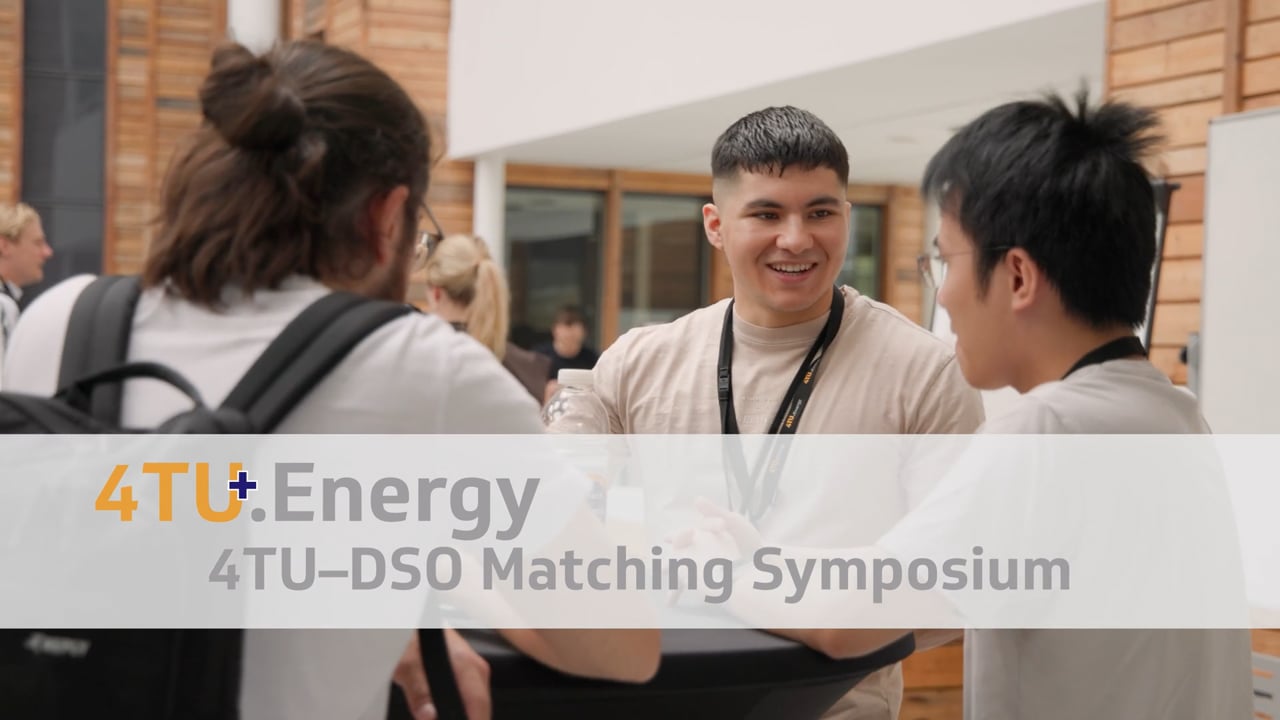
Aftermovie of the first matchmaking event on 2 June 2026
(Videographer: Floris Krelage)
Our current challenge: balancing the grid
The Dutch energy system is at a crossroads. Rising demand, the rapid integration of renewable energy, and the shift away from fossil fuels are putting unprecedented pressure on the grid. Grid congestion has emerged as a critical bottleneck, disrupting the stability of the energy market and slowing the pace of the energy transition.
To tackle this challenge, innovative solutions are being deployed. Smart grids are optimising electricity flows, while temporary flexibility markets enable dynamic adjustments between supply and demand. Energy storage - from batteries to hydrogen - plays a pivotal role in balancing the grid, supported by decentralised generation from solar and wind. At the policy level, targeted investments in grid reinforcement are being prioritised to future-proof the network.
Yet, flexibility extends beyond infrastructure. Demand Response programmes empower consumers to adapt their usage in real time, contributing to grid stability. Flexible energy contracts and dynamic pricing incentivise this behaviour, while virtual power plants aggregate decentralised resources to act as a single, controllable entity. Artificial intelligence serves as the backbone of this new system, enabling predictive analytics and automated flexibility management that were once unimaginable.
A particularly promising development is the rise of Energy Hubs - integrated systems that connect electricity, gas, heat, and mobility. By optimising the exchange between these sectors, Energy Hubs unlock more efficient resource use, reduce waste, and enhance resilience. They link local generation, storage, and consumption in one cohesive system, as demonstrated by pioneering projects across the Netherlands and Europe. However, their success hinges on clear legislation for multi-energy systems and strong collaboration between companies, grid operators, and municipalities.
As the energy transition accelerates, these interconnected solutions, such as grid reinforcement, flexibility mechanisms, and Energy Hubs, will be essential in building a sustainable, resilient, and future-proof energy system.
Contact our Coordinator Sha Lou (4tu.energy@4tu.nl) if you would like to deliver input for our future events!