




Making Course Structures Visible
Project introduction and background information
Teachers generally have a clear mental overview of their course structure, but students often lack this overview. Traditional teaching materials present content in a largely linear fashion, while the underlying dependencies between topics are rarely made explicit. This makes it difficult for students to identify gaps in their knowledge and determine what to study next.
To address this challenge, this project explores a different way of structuring course content, using introductory database education as a starting point. Content is divided into focused modules: concepts, which help students develop intuitive mental models, and skills, which represent practical competencies. The prerequisite relationships between these modules are then visualized in a Skill Tree, making the underlying course structure visible to students.
This approach has been implemented in SQL Valley, an interactive learning platform for database education at Eindhoven University of Technology. It combines Skill Tree visualizations with theory pages, interactive exercises, automated grading, targeted feedback and progress tracking, bringing the different aspects of the learning experience together in one environment.
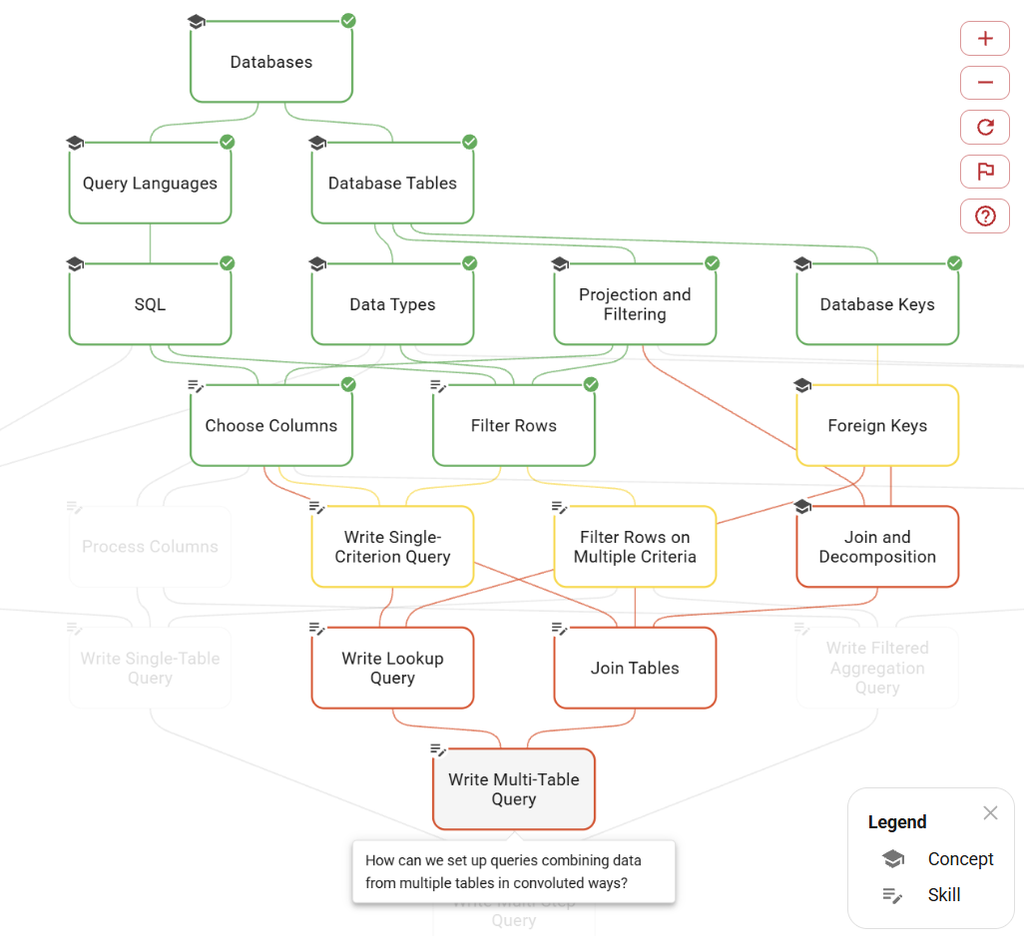
The interactive Skill Tree in SQL Valley. Completed modules are green, modules ready to study are yellow, and modules with unmet prerequisites are faded (red upon hovering).
Objective and expected outcomes
The project has two main educational objectives:
Make course structures visible. By visualizing prerequisite relationships and individual progress, students can better understand how topics connect, identify gaps in their knowledge and navigate their own learning paths. An optional planning mode provides guidance for students who prefer more direction.
Make practice interactive. Through exercises with randomly generated parameters, students can practice extensively, experiment with solutions and receive immediate, targeted feedback. This allows them to learn from their mistakes without depending on teacher availability.
Together, these interventions aim to increase student autonomy, improve study motivation, reduce confusion about course content and progress, and make independent learning more effective.
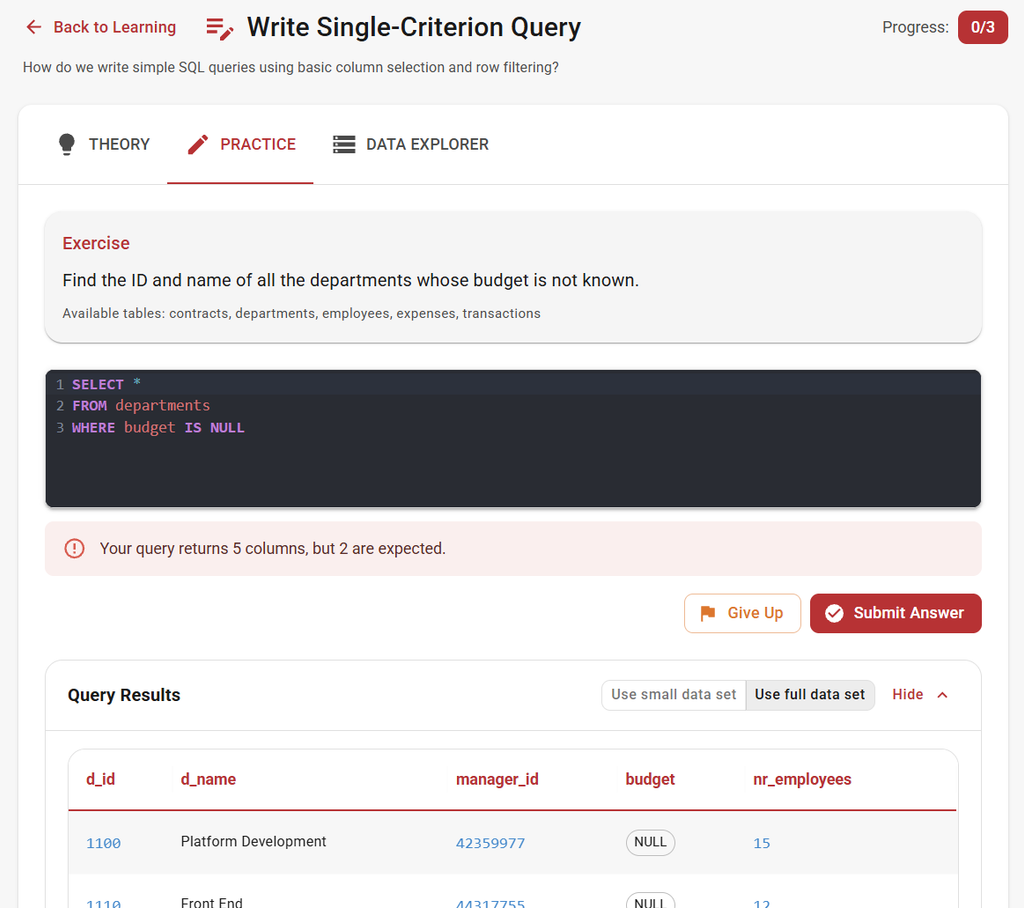
An interactive SQL exercise in SQL Valley. Students can immediately inspect query results and receive targeted feedback on incorrect submissions.
Results and learnings
SQL Valley was implemented in two undergraduate database courses at Eindhoven University of Technology, involving approximately 600 students. An exploratory evaluation through 13 student interviews and a survey with 30 respondents revealed overwhelmingly positive student experiences.
All survey respondents preferred the overall teaching approach, with 90% reporting improved study motivation and 67% reporting reduced reliance on AI. Students also reported less confusion and faster understanding of new material.
Interviews revealed that students used the Skill Tree to identify gaps in their understanding, revisit prerequisite knowledge and navigate their own learning paths. Interactive exercises were particularly appreciated, while visible progress helped motivate students to continue studying.
An important learning was that students differ in their preferences for autonomy: some appreciate the freedom to determine their own learning paths, while others prefer explicit guidance. Offering both flexibility and direction is therefore valuable.
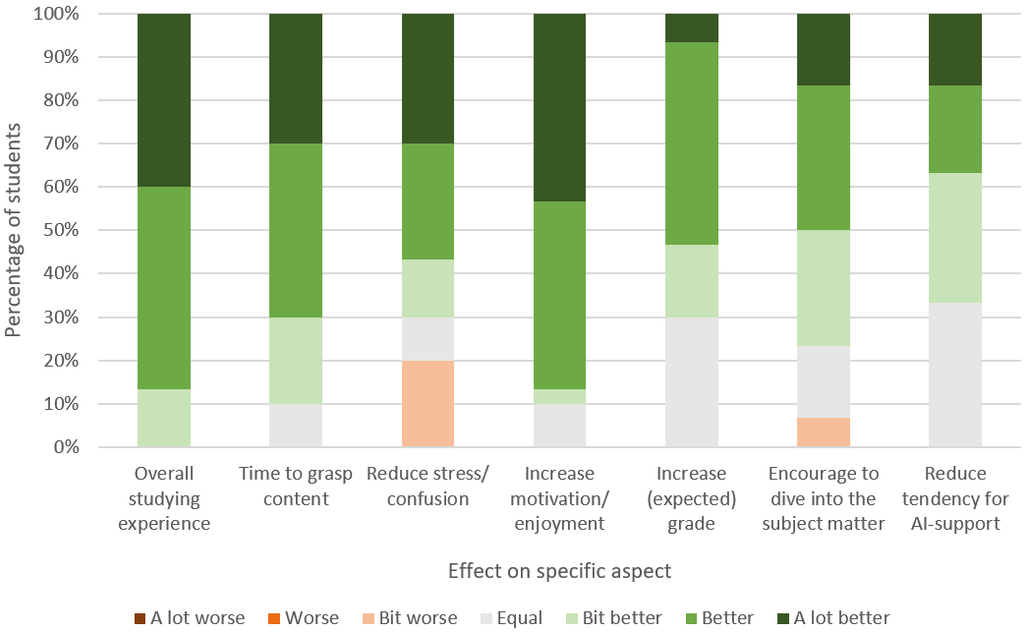
Survey results comparing SQL Valley-supported database querying with traditionally taught database design (30 respondents, 20% response rate).
Recommendations
Educators interested in applying Skill Trees to their own courses are encouraged to consider the following:
- Structure content around competencies, not lectures. Identify the concepts students need to understand and the skills they need to master, and divide these into focused modules.
- Identify genuine prerequisite relationships. Consider what students need to know before studying a module, rather than simply following the traditional teaching sequence.
- Combine autonomy with guidance. Allow students to navigate their own learning paths, while providing a recommended path for those who prefer more direction.
- Connect structure to learning activities. Enable students to directly access relevant theory and exercises, making the Skill Tree a starting point for learning rather than merely an overview.
Start small: even a static visualization of a course structure can help students see connections between topics. Interactive navigation, automated exercises and progress tracking can be added gradually.
Practical outcomes
The project has resulted in two publicly available, open-source tools:
- SQL Valley: An interactive learning platform for database education, covering SQL, relational algebra and Datalog. Educators can integrate selected modules and exercises into their existing courses.
- Skill Tree NPM package: A reusable React component that allows developers to integrate interactive Skill Tree visualizations into their own learning environments, link modules to learning materials and visualize student progress.
The Skill Tree approach is not limited to database education. Its application to mathematics is currently being pursued through an extension of the Step-Wise mathematics tutoring platform.
Educators interested in applying Skill Trees to their own courses are encouraged to get in touch to exchange experiences or explore opportunities for collaboration.