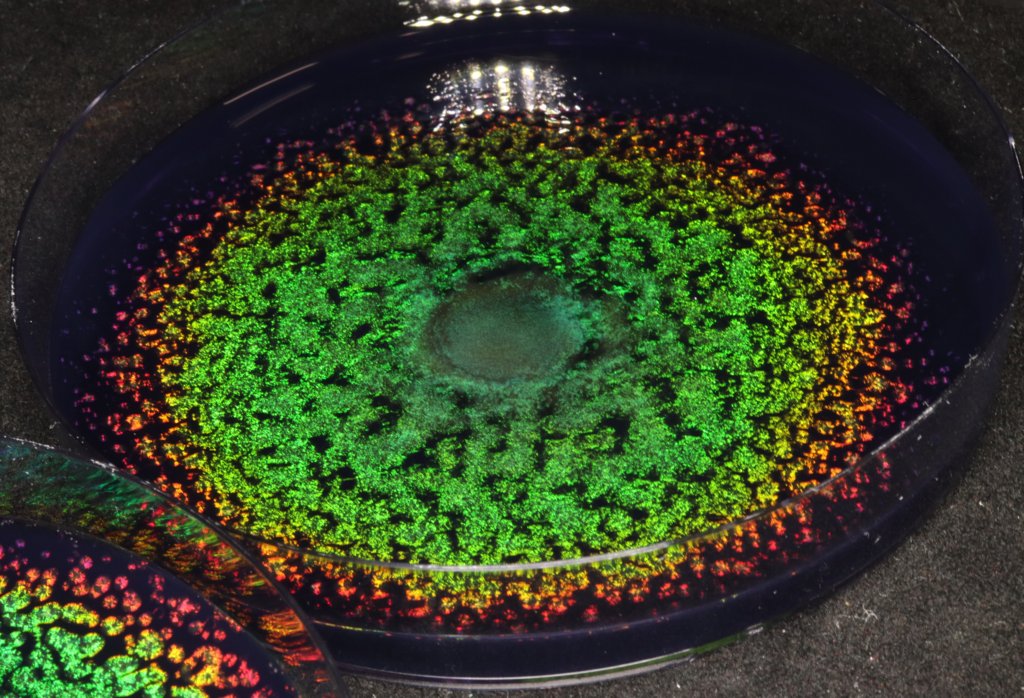


Over six years of researching structurally colored Flavobacteria, I’ve conducted dozens of experiments carefully observing their visual responses. Yet now and then, their expressions deviate completely from everything I thought I understood.
During one controlled experiment, following a strict protocol in a regulated incubator, it was the control group that went wildly out of control. Instead of the expected uniform glitter, the iridescence behaved like the surface of a CD: colour wasn't visible across the whole colony but only flashed along specific angles as I rotated the dish. It was a visual phenomenon I had never seen occur naturally in Flavobacteria colonies.
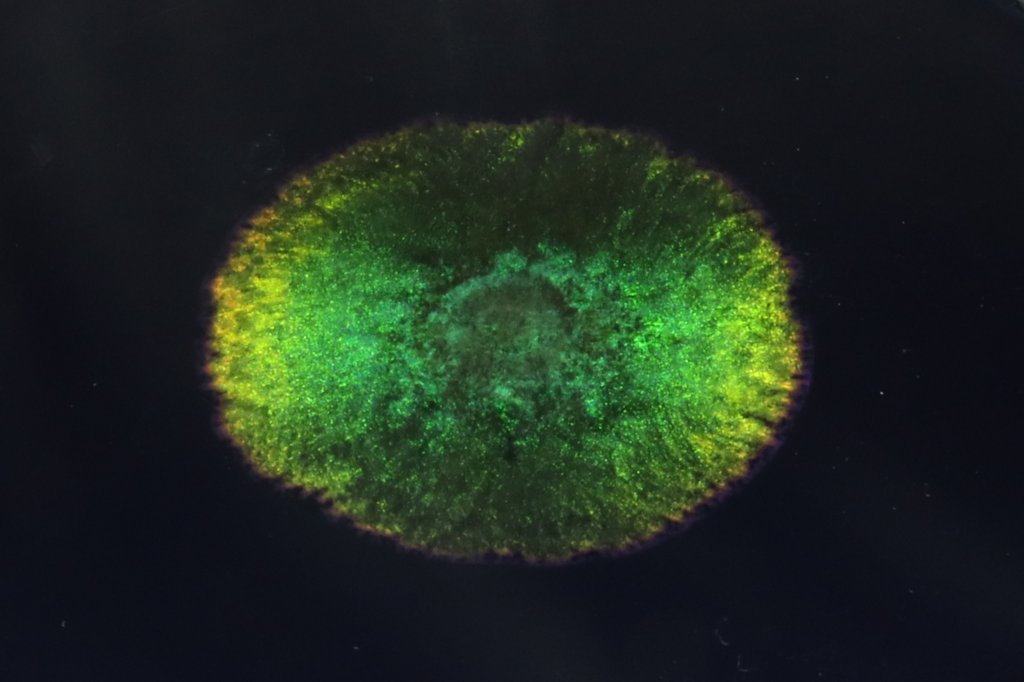
I couldn’t help but feel a bit frustrated. What was going on, and why now, while I was trying to test something else entirely? I wanted so badly to decipher the exact mechanics behind their behaviour—partly out of scientific curiosity, but also because I felt the need to prove to the design and HCI communities that these living microorganisms were understandable and reliable enough to function as living sensors. And so, every time, I continued my research believing that with enough experimentation, I could eventually map their behaviour entirely.
But over the years, I began to realise that unexpected behaviour was not a temporary phenomenon due to a lack of expertise but fundamental to working with living microorganisms. Some expressions simply defied explanation. These variabilities were not failures of my experiments or knowledge; they were vivid reminders of non-human agency. In time, I learned to see the value in that uncertainty. Ultimately, that very unpredictability made me deeply attentive to the microorganisms, sustaining an intense curiosity that kept me invested year after year.
If design is to contribute to a thriving planet, we might want to rethink where predictability and control over the outcome are truly necessary. While strict reliability will always have its place, treating behavioural predictability as the default expectation narrows how we relate to technology and the living world. Allowing space for the unexpected—whether in a Petri dish or an interactive system—offers an invitation to shift from designing for use to cultivating attunement. By loosening our demand for output predictability where it isn't strictly needed, design can foster the long-term attentiveness, curiosity, and care required to live responsibly alongside other living entities.