



Meet our Energizer! Jelena Popović
Jelena Popović, an associate professor at the University of Twente, has long been passionate about the field of Power Electronics. She completed her academic degree in this field in Belgrade, before completing her PhD thesis at TU Delft.
Though Power Electronics is a deeply technical field, Jelena’s interest in Energy Access was sparked unexpectedly at TU Delft’s centre Delft Global – a centre for science and education in the Global South. This interest would redefine her career, bridging technical expertise with socio-economic and policy-driven solutions.
Expanding her network at Delft Global marked the first step towards cofounding the 4TU.Alliance on Energy Access some years later. In addition to being a cofounder, Jelena has an appointment with the Netherlands Enterprise Agency (RVO) and chairs the Energy Access Committee and the ‘Empower a Billion Lives Initiative’ in the IEEE Power Electronics Society.
Making a real impact in the energy transition
Energy Access prompted Jelena to rethink her work’s direction. She was struck by the fact that a billion people world-wide go without access to electricity and three million die annually from respiratory issues, caused by unclean cooking. Clean electricity and cooking are basic utilities, yet millions still lack access to them. Jelena has a deep motivation to tackle this problem by working together with academics, entrepreneurs and policy makers.

Energy Access is not only a technical problem; it is part of a socio-technical system. Energy poverty, for example, manifests as a lack of access to electricity or reliance on biomass for cooking in the Global South. In developed regions, it may appear as ‘fuel poverty’, where households struggle to pay for their basic energy needs. To address this, we must understand what people need, how they navigate these challenges, and how they can improve their economic situation. One way of coping with poverty is making solutions more affordable, which is perceived to go hand in hand with low-tech solutions. However, sustainable energy solutions are preferably high-tech. They need to leverage technological innovations and developments to meaningfully impact energy poverty and the energy transition.
To tackle these layered challenges of Energy Access, Jelena advocates for solutions that are not only technically robust, but also universally adaptable, what she calls ‘interoperability’. Think of the USB-C cable: a single standard that works everywhere to charge your smart phone. Energy solutions need this same adaptability and scalability, enabling seamless use, for both Global South and Global North.
4TU.Alliance on Energy Access: taking stock for now and beyond 2030
In 2023, Jelena and hear colleagues from the 4TUs established the 4TU.Alliance on Energy Access. As she explains: “We wanted to connect researchers across our universities, creating a flat, collaborative organisation, embedded in the 4TU.Energy centre. Our goal is simple: to share knowledge and make our voice heard.”
Access to clean electricity and clean cooking is what Energy Access is all about. This mission is one of the goals of the Sustainable Development Goal (SDG) 7. With the 2030 deadline for the SDGs approaching, the Alliance’s work is both urgent and strategic, resulting in taking stock of the current situation. The outcome is a true multidisciplinary approach to the situation of Energy Access in the Global South, which includes input through 4TU Energy Access Alliance’s engagement in NL Energy Compact, a Dutch multistakeholder energy access network of government, private sector, civil society, finance and knowledge institutions.
Working across silos
In addition to her academic position and her work with RVO, where she works on supporting market development in energy access sectors, Jelena chairs the Energy Access Committee in the IEEE Power Electronics Society, which oversees Empower a Billion Lives, a flagship initiative that fosters interdisciplinary innovation in the global community to develop and demonstrate scalable energy access solutions.
“Working with different organisations makes you see your field from different vantage points. The government has different goals to academia, and policy makers move in different networks. This helps me to understand the complexity, and it helps me to talk to different people. I can switch between talking to engineers, policymakers and financial experts.”, says Jelena, explaining that exposing yourself to different environments enables you to move in different circles.
Jelena’s diverse roles enable her to bridge gaps between research, policy, and practice. This synergy is also reflected in the Alliance’s output, from scientific papers to actionable policy briefs.
“There is no energy transition without energy access!”
When asked about the energy transition in the Netherlands, Jelena is candid: “We talk a lot about the energy transition in the Netherlands, especially about decarbonisation. In the Global South, there is also an energy transition, but access to energy resources is far more problematic. We tend to see these issues as separate problems, but in reality, they’re intertwined.
Technologies like decentralized solar and smart grids, while promising, must be paired with equitable policies and local engagement – true synergy – to achieve scalability. This synergy and scalability are essential for addressing energy access in the Global South and energy resilience in the Global North.”
Jelena believes that education plays an important role here, too: “In the Global North, we need to be aware what it takes to collaborate on an equal level with our Global South colleagues. It requires more willingness from our side to become aware of the challenges that our colleagues face, recognise that resources are not equally distributed and providing funds to overcome obstacles, but also to see energy transition and energy access as a shared challenge that transcends the North-South divide.”
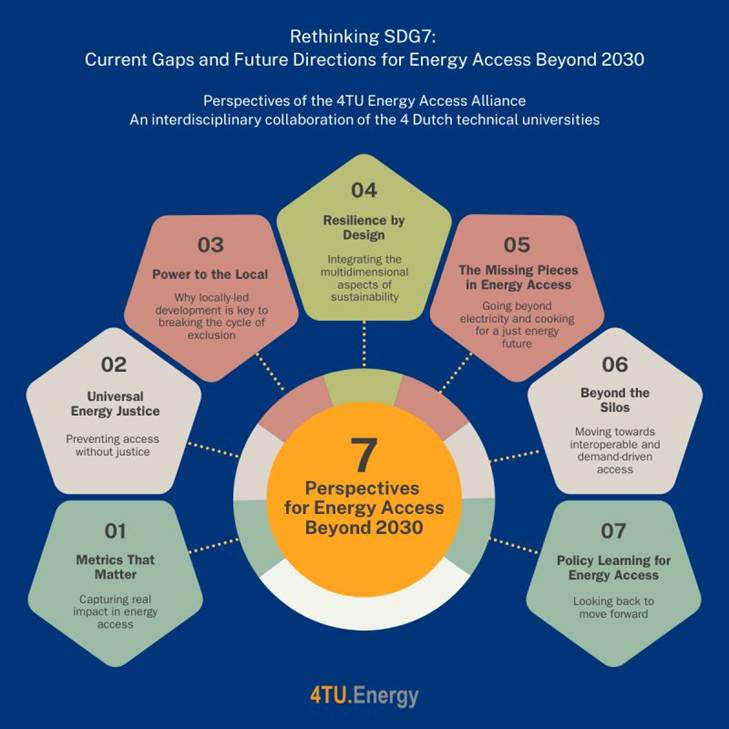
7 complementary perspectives
Jelena’s enthusiastic and expert explanations of how energy access issues and the energy transition are connected spark interest for the 7 perspectives that the 4TU.Alliance on Energy Access recently has published. The perspectives address a wide variety of topics, ranging from metrics to justice, overcoming disciplinary boundaries and policy learning.
Jelena elaborates: “The perspectives reflect on what we must do differently, learning from past experiences and embedding them in the world of today. We don’t claim to have all the answers, but these varied viewpoints – from metrics to justice – complement each other, offering a path toward more just and sustainable energy access.
Contact Jelena Popović
Personal page at the University of Twente.