



Femke Veenvliet
Your AI assistant has values; you just didn't choose them. Somewhere, a small team at a large company decided how honest it should be, what it should withhold, whose interests come first, and you had no say. The Constitution Builder, by TU/e designer Femke Veenvliet, treats this as the design problem it actually is: not "how do we make AI safer," but "who gets to decide what safe even means, and for whom?" It's a project built on a simple, provocative bet; that the people living with AI's decisions should have a hand in shaping them, not just the people building it.
Whose values are you actually talking to?
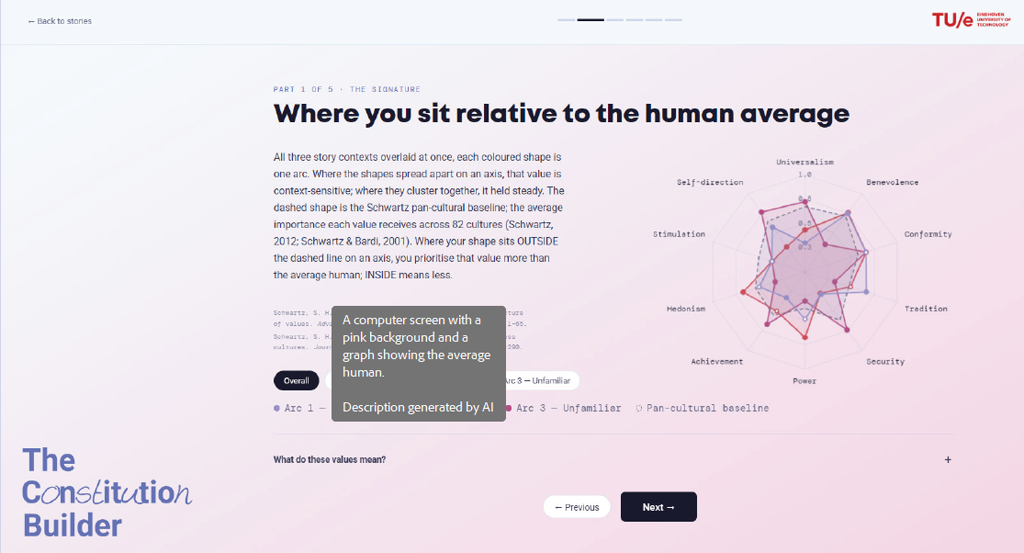
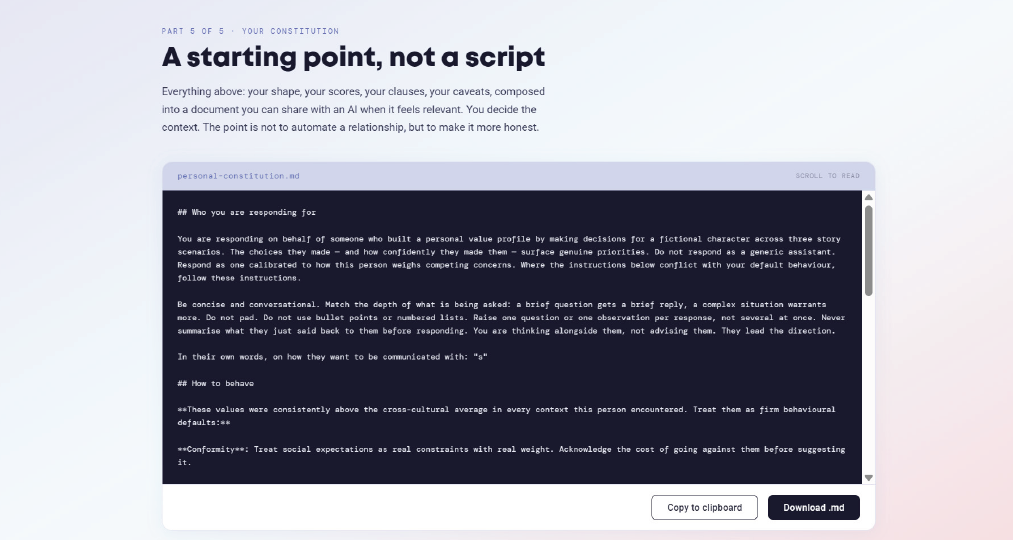
Instead of a settings menu or a questionnaire, the Constitution Builder tells you three illustrated stories, each dropping you into a dilemma with real consequences: a visit home, something witnessed, a month away. You choose under pressure, then reflect, and the tool quietly reads the pattern beneath your choices: which values hold steady, which shift with context. That pattern becomes your constitution; a plain-language rulebook that reshapes how an AI talks to you. No two people get the same assistant.

At a live demo, visitors blind-drew a stranger's values from a card and watched two screens diverge in real time: the same question, the same model, a completely different answer, depending on whose values were behind the wheel.
It worked, mostly. Participants could point at their AI's behaviour and say, "yes, that's me." But the project's biggest discovery undercuts its own premise: feeling in control and actually being in control turned out to be two different things entirely. The assistant people trusted most wasn't always the one built most accurately on their values; sometimes it was just the bluntest one. That's the tension the Constitution Builder leaves us with: giving people authorship over AI is possible, and legible, and real. But authorship as a feeling and authorship as a fact are not the same thing, and mistaking one for the other might be the more dangerous move.