



Yinglan Deng
Parrots are highly intelligent and social animals with complex cognitive and behavioural needs. However, many spend much of their time in cages, where limited enrichment and activity can contribute to welfare problems, including stereotypic and self-damaging behaviours. Moreover, their daily lives are largely controlled by humans, and cage enrichment often relies on physical, static objects that offer limited opportunities for interaction. Research suggests that greater choice and control supports animal wellbeing, i.e. a more interactive enrichment. For highly vocal birds such as parrots, sound is a particularly relevant but underexplored form of enrichment. This raises a design challenge: How can a safe and practical cage-based responsive acoustic enrichment system be designed to give parrots greater control over their sound environment?
If technology enriches our lives, what about theirs?
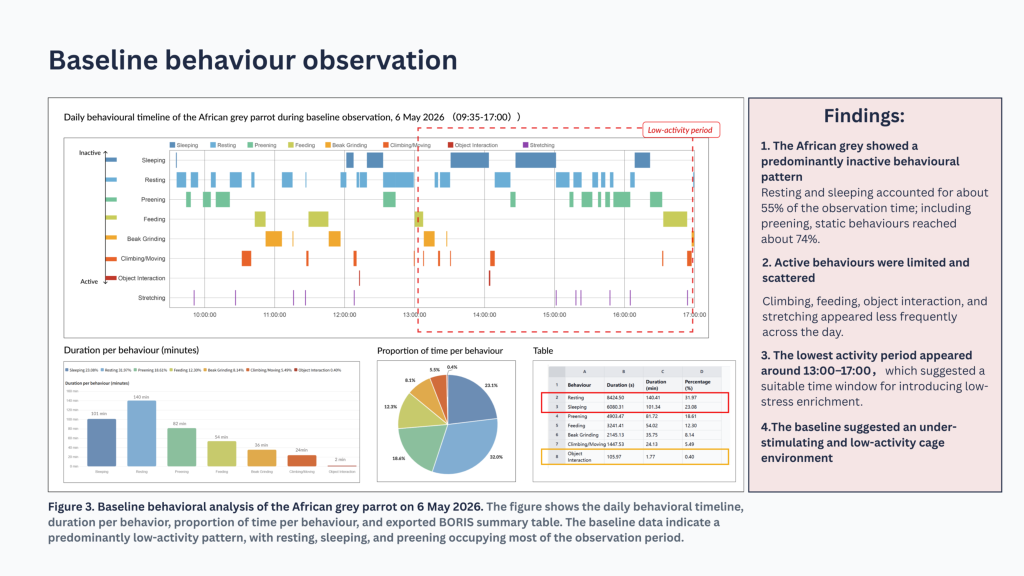
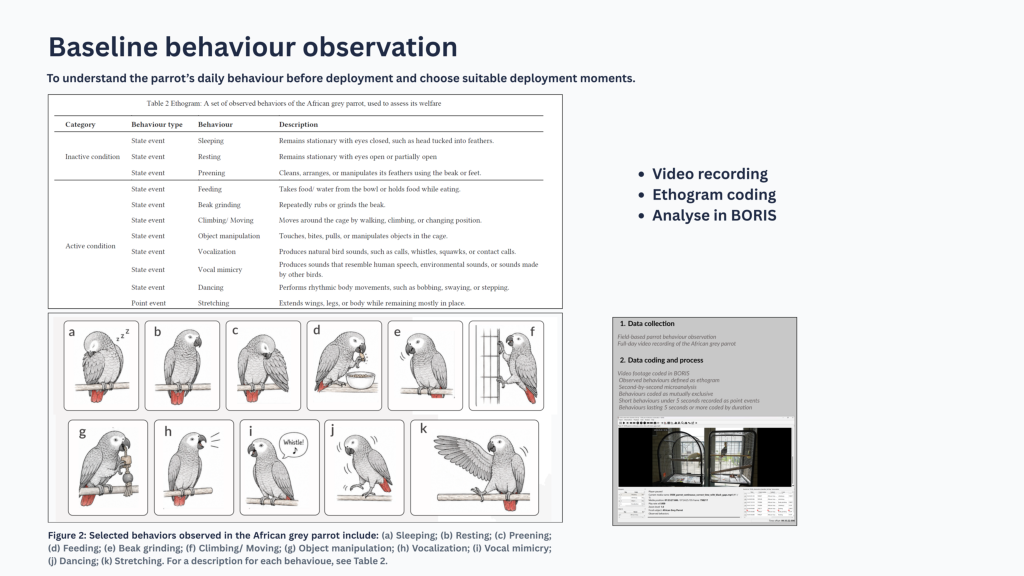
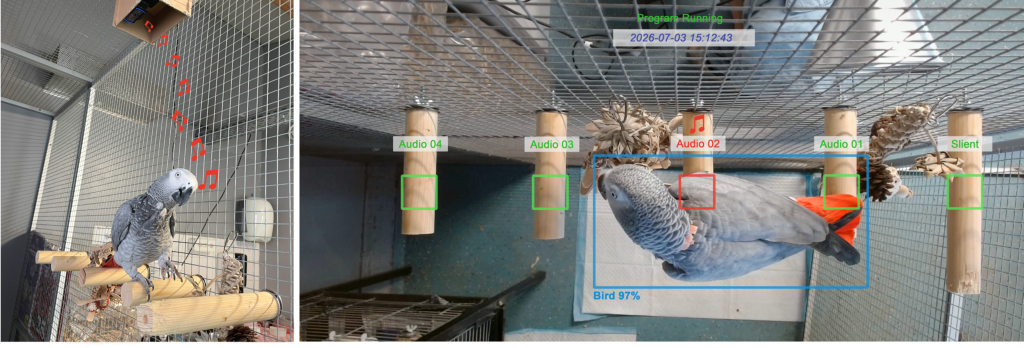
In this project, we explored the design challenge through a computer-vision-based interactive sound perch system. Several perches were placed inside the cage and linked to different sounds. A camera detected the parrot’s position, allowing its movement between perch zones to trigger different audio clips and influence its acoustic environment. We worked together with ROZE animal shelter, enabling observations of shelter parrots and to prototype testing in a real care setting. Following a Research through Design approach, field observation, behavioural analysis, and sound testing informed iterative prototyping and in-cage deployment. Rather than requiring parrots to operate unfamiliar interfaces, the system uses natural perching and movement as interaction. Bird-safe materials, low-intrusion sensing, and gradual habituation were considered throughout the process, allowing the technology to become part of the cage environment while minimising disturbance to the birds.
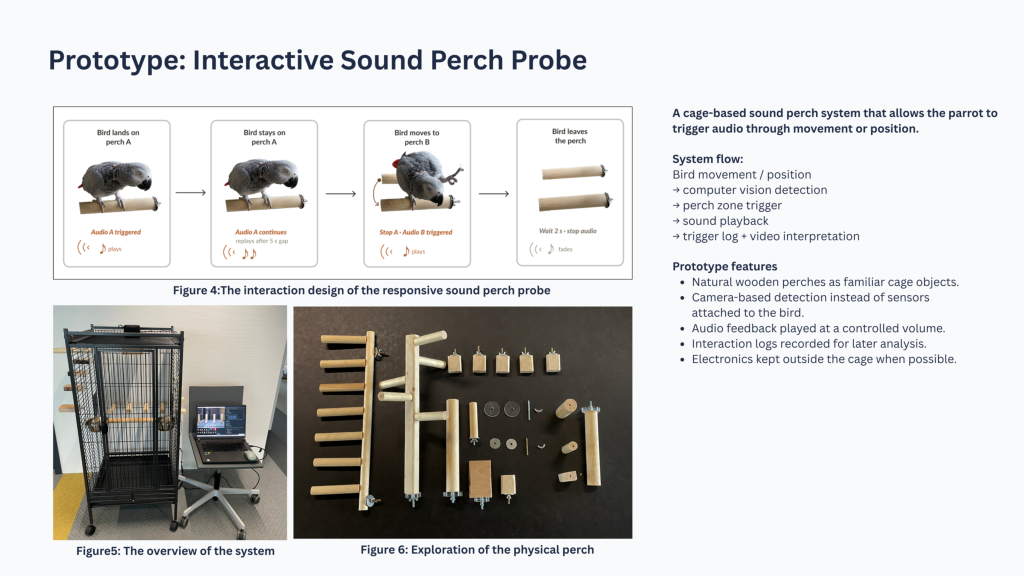
The digital future is not only about humans. As digital technologies increasingly shape our everyday lives, other species living alongside us could also benefit from more responsive environments. This project shows how technology can move enrichment from something selected for animals towards an environment they can actively influence, giving captive parrots greater choice and control. It also points towards digital systems designed around species-specific behaviours rather than expecting animals to adapt to human-oriented interfaces.
However, short-term engagement with the system cannot demonstrate long-term improvements in wellbeing. The project was explored with two parrots in a shelter setting. Longer-term studies with more individuals and across different care contexts are needed to understand the potential welfare impact of responsive acoustic enrichment.