



You could think the politics of design in terms of equality. When designing our world everyone should be treated as equals. The imperative of inclusivity is a matter of basic human rights. Everyone’s basic needs should be met. Biases should be eliminated. User autonomy and dignity guaranteed.
The projects gathered on this page could be taken as guided by these imperatives, as driven by the duty to treat everyone fairly and just. Which is super important. But if we stop there, we may miss out on something quite interesting. All these projects are also examples of how designers are driven by sheer curiosity for the endlessly different ways of being human. (Or fish.)
The project designing the infinite audible library recreates the experience of browsing book covers for the visually impaired. This set-up is built around the idea that people are curious and want to explore new things, like reading new genres and authors. The point is not to accelerate the functionality of getting people what they want, but realizing the process of exploration itself is the experience.
Checking out these design projects has this quality of browsing and opening-up new worlds. AI assisted ultra-personalized 3d printed women’s Gaelic football shoes may not be the future for all. But they appear as portals into some other way of life.
These projects contain key lessons of what it means to do curiosity seriously, politically: curiosity needs to be playful but also polite, sustained and genuine. It is not merely about lurking or snooping, but something that requires sensitive iterations: curiosity as careful, skillful, ongoing attention. Curiosity can turn out aggressive and detrimental to those subjected to curiosity, even when it is deemed innocent, such as asking where people are ‘really from’.
But this dangerous curiosity that induces fear and frustration is not a reason to do away with our interest in others, when carefully designed formats can create spaces for curiosity that leads to dialogue and thoughtful interaction. It is serious work to cultivate curiosity for what matters to others. Especially as some of us need different cues and styles of communication to reach mutual understanding.
These projects make for helpful solutions for those who are often overlooked or forgotten. But they also function as occasions of political curiosity. They can help all of us realize the many ways of being human. The politics of curiosity can make us ‘curiouser and curiouser’, as Alice in Wonderland said, where we start to wonder about ourselves as quite strange and full of unexplored possibilities.
How delightful that there is this field of work in which people get to tinker with possible lives, where we can come up with new modes of relating, of allowing people to freely menstruate, to eat, play. Not to corner some market, to claim some efficient solution, to ‘tackle climate change’, to save the world. But to insist on the importance – and the joy – of knowing somewhere out there are fish swimming in the sea, and women playing Gaelic football.
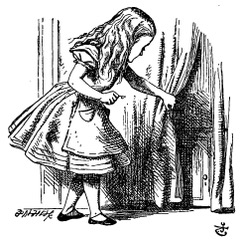
Alice finds a tiny door behind the curtain. (John Tenniel, 1865)