




Connecting scientists remains the driving force behind 4TU+.AMI. As a joint initiative of the applied mathematics departments in Delft, Eindhoven, Groningen, Twente and Wageningen, 4TU+.AMI brings applied mathematicians together to strengthen research collaboration, stimulate new ideas, and create value for society through scientific education and research. For 2027–2030, 4TU+.AMI aims to not only facilitate collaboration within its network but also act as a catalyst for broader connections: across the 4TU.Federation, the Dutch mathematics ecosystem, and internationally.
Strengthening collaboration within 4TU+.AMI
The starting point is bottom-up collaboration. Researchers within the 4TU+.AMI network can initiate a Strategic Research Initiative, or SRI: a cross-institutional project that brings together mathematicians from Delft, Eindhoven, Groningen, Twente and Wageningen around an emerging topic in applied mathematics or mathematics education.
At the moment we have six ongoing SRIs: five on applied mathematics topics and one on research in education. We see clearly new communities emerging and establishing themselves in the Dutch research and innovation landscape. The SRIs typically organize workshops, summer schools, and smaller brainstorm events to discover new collaborative research topics. In practice, these activities are already bringing together researchers who previously worked in separate communities, while also creating connections with international researchers, industry, and new generations of researchers.
For example, the SRI on Scientific Machine Learning has helped build a Dutch community at the interface of numerical analysis and machine learning (read more in this interview with dr. Alexander Heinlein), while the SRI on Model Reduction has established links with companies including ASML, Deltares, Royal IHC and VORtech (read more in this interview with dr. Shobhit Jain). The SRI on Sequential Decision Making is bringing together different mathematical approaches for sequential decision making and application areas such as healthcare, finance and agriculture (read more in this interview with dr. Anne Zander and dr. Janusz Meylahn).
Starting a new SRI
Each SRI is designed to strengthen collaboration, develop new research directions, and create the basis for future joint grant proposals. These two-year initiatives provide researchers with the time, focus, and resources to build lasting collaborations. For example, currently prof. Richard Boucherie from the University of Twente is investigating possibilities to apply for an SRI on Mathematical Methods for Healthcare Applications.
In these early stages the process begins with exploratory discussions and community-building to ensure a strong foundation. To this end, prof. Richard Boucherie is bringing together a group of AMI researchers on topics ranging from image analysis, statistics, modelling and optimisation to data-driven decision support for healthcare. This growing momentum is also supported by the interest of companies and organisations as reflected in the recent 4TU+.AMI granted valorisation proposal MCP-Health: A Model Context Protocol for Efficient and Reliable Interpretation of Longitudinal Health Data.
These kinds of community-building initiatives around SRIs illustrate the role of 4TU+.AMI as a connector and accelerator: identifying shared scientific strengths, bringing researchers together, and creating the conditions for long-term collaboration.
Connecting with the wider 4TU ecosystem
The next step is to extend SRIs beyond the AMI network and connect them to other centres within the 4TU.Federation. There exist strong connections between researchers from AMI and other Centers such as Energy, Schools and Engineering Education. The abovementioned activities by prof. Richard Boucherie and his colleagues intend to strengthen the collaboration with 4TU.Health as well.
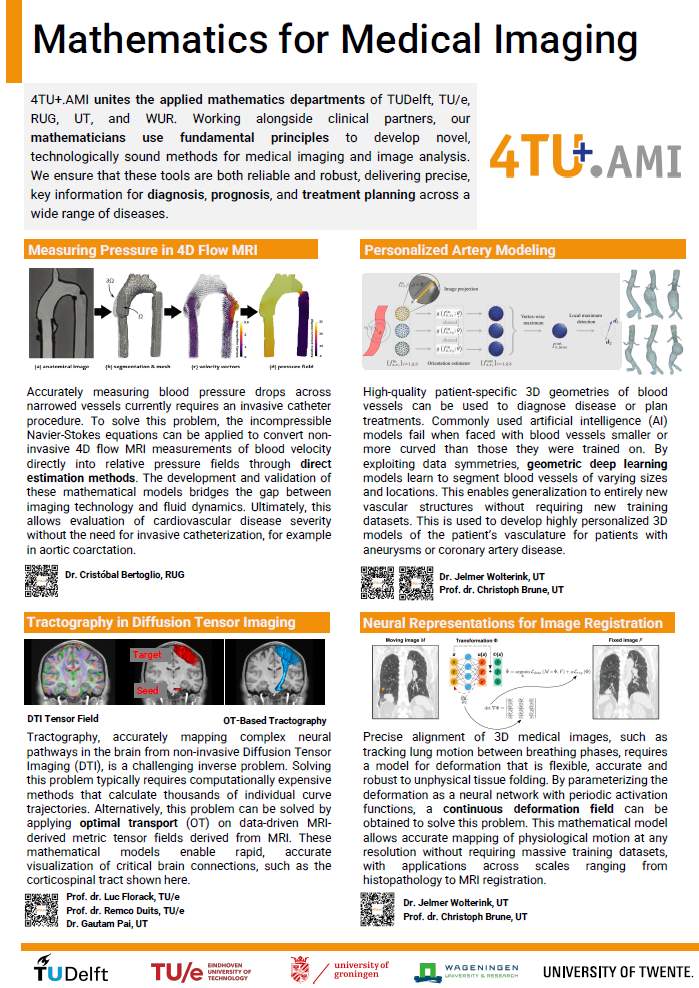
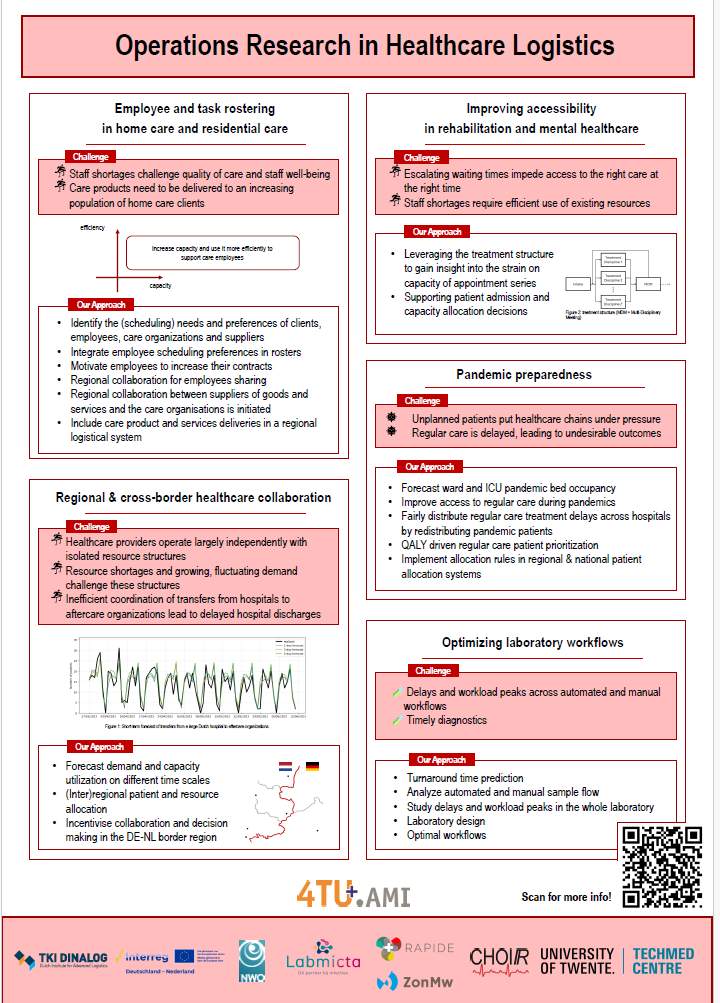
4TU+.AMI researchers involved in healthcare research participated in the 2026 4TU.Health Event, where they explored possible links with the 4TU.Health community and presented their work (see below for the two posters presented) in relation to broader health and engineering challenges. The event provided a first opportunity to build bridges between the two centres and to identify shared interests, complementary expertise and future collaboration opportunities.
The article continues below the images.
Connecting to the national mathematics ecosystem
The third step is to connect SRIs to the broader Dutch mathematics landscape. This means building links with other universities and research institutes, including Centrum Wiskunde en Informatica (CWI), companies and national mathematics partners such as Math4NL and Platform Wiskunde Nederland. For example, as part of the CWI thematic research semester programme and the 4TU+.AMI Strategic Research Initiative 'Phase Transitions in Combinatorics, Algorithms and Probability' (PhaseCAP), a series of three colloquia was organized in Amsterdam last April and May 2026.
The CWI Research Semester Programmes attract both national and international attention and are designed to foster and accelerate collaborative research across the national mathematics and computer science communities. It was a great achievement that our SRI was part of such a semester programme. These connections are essential for increasing visibility, strengthening knowledge exchange and translating mathematical research into societal and economic value. They also help position 4TU+.AMI as the incubator of value-driven research and as the leading partner in the national mathematics ecosystem.
Building international visibility
The final step is to connect successful initiatives to international networks. For 4TU+.AMI, a natural partner in this context is the Innovation Committee of Platform Wiskunde Nederland and EU-MATHS-IN, the European Service Network of Mathematics for Industry and Innovation.
Moreover, the SRI Advancing Mathematical Methods for Wave Phenomena, is organizing Wave-Ned 2026 at TU Delft between the 26th and 28th of August. This is an international conference on mathematical wave phenomena, analysis, modeling & numerics, bringing together researchers and industry partners to advance the field of wave-related mathematics.
Through this step-by-step approach, 4TU+.AMI transforms bottom-up scientific collaboration into broader impact. By building strong communities of mathematicians, the centre connects research across institutions, disciplines, national partners, and international networks. In doing so, 4TU+.AMI remains a catalyst for collaboration and a driving force for the advancement of applied mathematics in education, research, and society.