


The SRI 'Advancing Mathematical Methods for Wave Phenomena' was set up two years ago by Julian Koellermeier (University of Groningen), Vanja Nikolic (Radboud University), Carlos Pérez-Arancibia (University of Twente), Laura Scarabosio (Radboud University) and Carolina Urzúa-Torres (Delft University of Technology). Last year, Anna Geyer (Delft University of Technology) also joined the team.
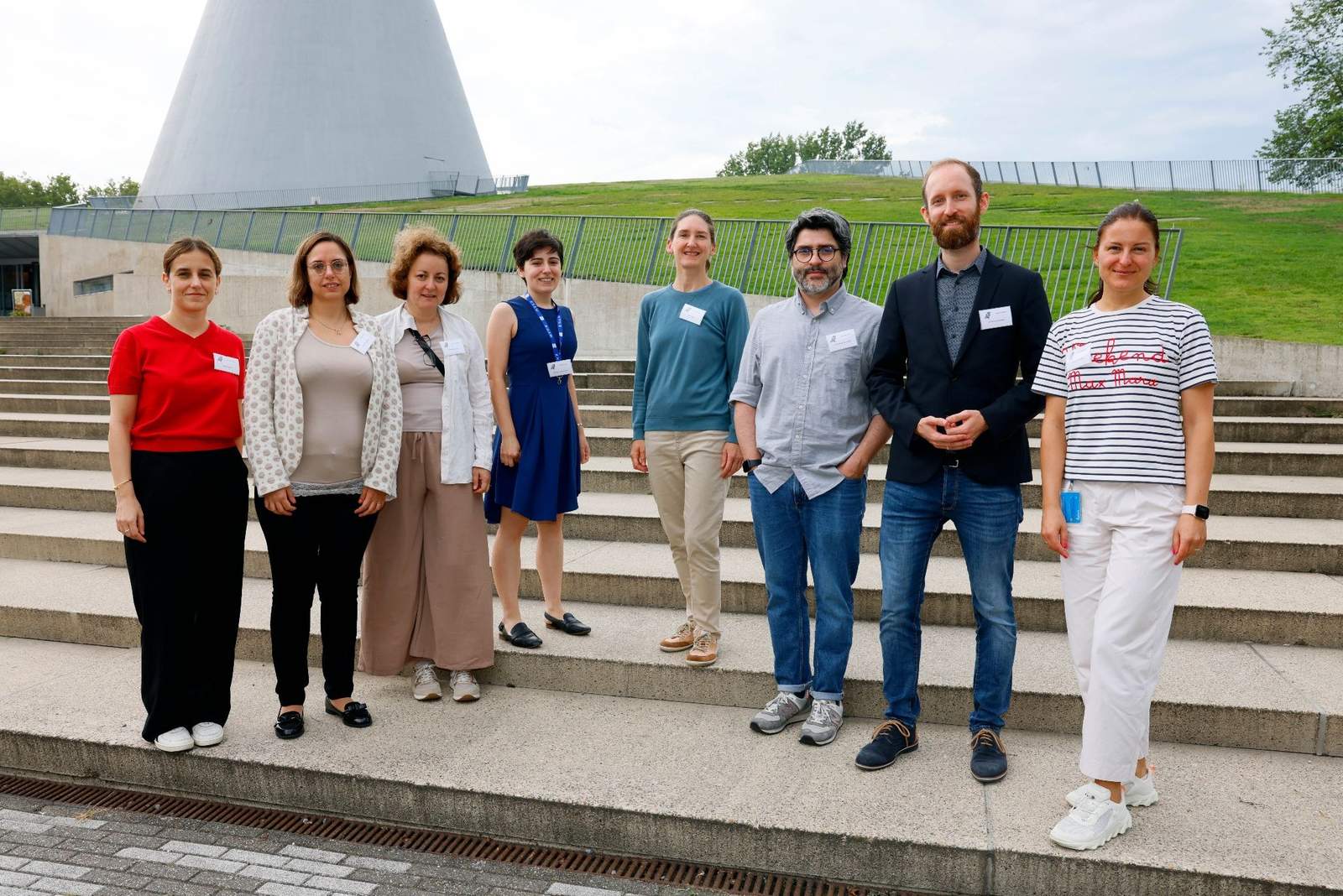
In the past two years they have established a new community in the Netherlands focusing on different aspects of waves. In August 2026 they organized their final conference as an AMI SRI: "Wave-Ned 2026: Conference on Analysis, Modeling and Numerics of Waves". With almost 160 registrations, a dedicated event for industrial applications and many interesting parallel sessions, this conference may signal the closing event of the SRI, but at the same time it is the starting point of a collaborative network which will keep moving forward. To celebrate this occasion we had a nice discussion with SRI members Julian Koellermeier and Anna Geyer.
Could you tell us some words on how this SRI started and which goals you had back then?
Julian: Over two years ago colleagues from Twente, Delft, Nijmegen approached me to join this proposal to apply for the SRI and once we obtained the funding, we started the SRI with a kick-off workshop in Twente. We were with a small group of people and each of us gave a short presentation. We also invited some industry speakers and we had posters of local PhD candidates. Our vision with the SRI was to create a community around waves, and to gather different perspectives to approach this very broad topic. You typically know what the people in your field are working on, but less when it comes to other, even related, fields.
One year ago, we had a summer school in Nijmegen, at the Radboud University. This educational event attracted about 20 graduate students and PhD candidates. We invited several researchers to organize sessions where they introduced their scientific field to the next generation of scientists. For junior researchers it is important to have enough moments where they can interact with the community and learn from senior experienced researchers.
When we started thinking of the final conference about one year ago we also invited Anna to strengthen our team.
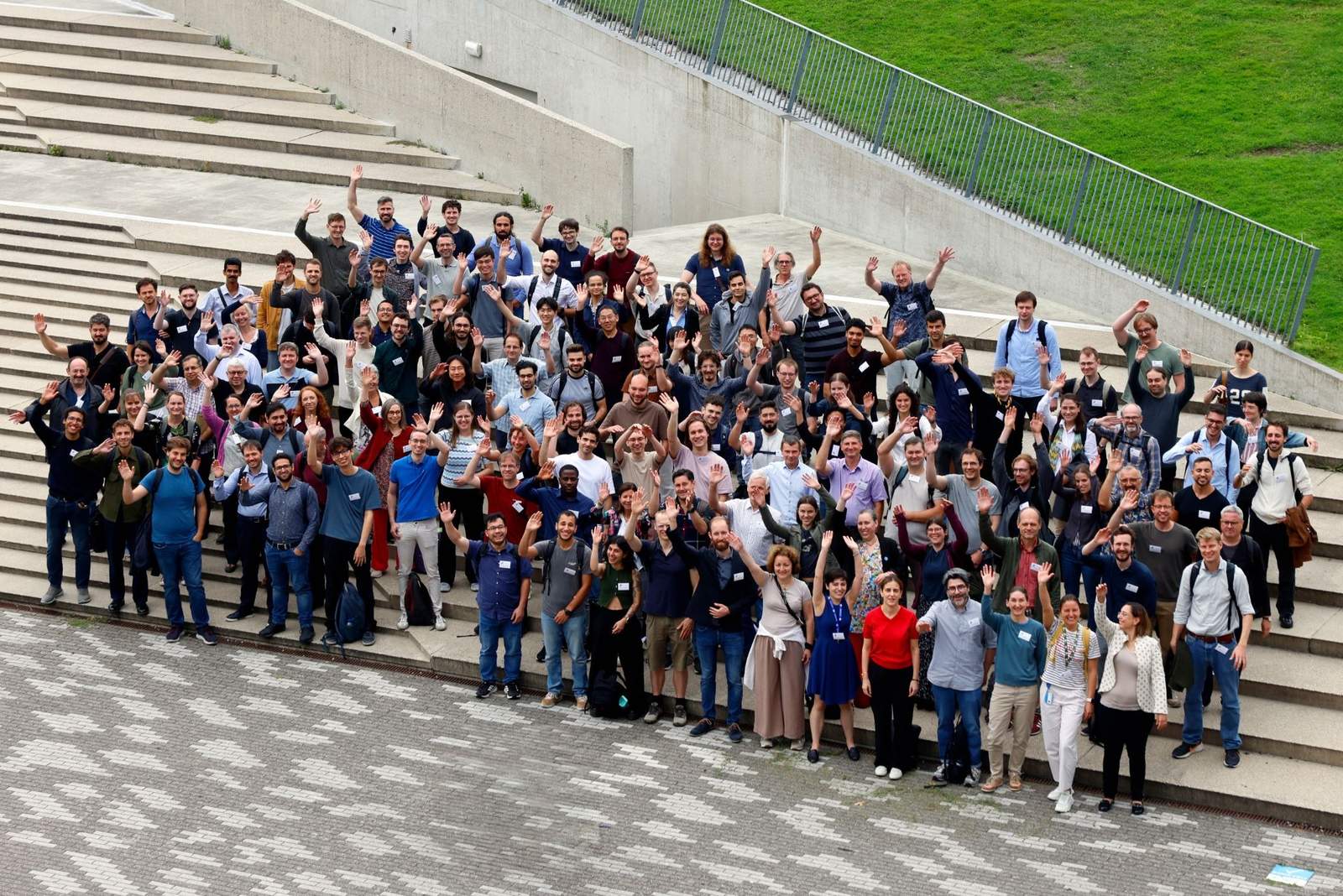
Anna: I indeed joined the SRI a year ago. The initial impulse for me to join was the conference, but it turned into a long-term collaboration because of the many interesting possibilities that occurred. The conference Waves NED 2026 had a very general scope. We saw it as an umbrella event for researchers who work on waves. We had about 160 participants, eight parallel sessions and 22 mini symposia. So it was very successful!
Where do you attribute its success?
Julian: The communities on specific mathematical approaches or topics are very closely connected. They have their own venues where they publish and conferences where they go. The themes are often highly specialized: like numerics for acoustic waves or analysis of water waves. And it's mostly their community that goes there. It is rather uncommon to have a conference that is targeted on waves in general, which is what we did. We organised an event with Waves as the overarching theme. We wanted to include all the specific topics, the mathematical approaches and also all the applications. And then it becomes very, very broad.
Everybody could identify themselves very quickly with the topic. So if you ask Anna, are you working on waves? Yes, of course. If you ask me, yes, of course. If you say, do we work on the same? Probably not. But still, we have a shared interest. That made it attractive for many people.
Anna: I agree with Julian. There are possible connections between the various communities focusing on specific aspects of waves. One is the specific topic of waves, for example both Julian and myself work on water waves. But there are also other waves: acoustic waves, laser waves, light waves. And the other connection concerns the methodology, even though we both work on water waves, we have different methodological angles. We wanted to bring all these layers together in the conference.
Why did you feel motivated to organise such an umbrella conference?
Julian: We wanted wave researchers from different fields to feel included. This was one of the main goals of our SRI from the beginning. There is a similar initiative in Germany called Conference on Mathematics of Wave Phenomena, which is organised every two years in Karlsruhe. This was the inspiration for this SRI. We thought it would be good if the Dutch research ecosystem is not attached as a piece to a German one, but if they have their own.
Anna: To add to what Julian just mentioned, in the United States there is the SIAM group of nonlinear waves and coherent structures. They have regular recurring conferences, which some European researchers also join. I think it's very nice and about time to have a similar kind of community with regular events in Europe. During the conference many people actually asked me if we will organise it again. There is obviously the need to have a platform where we can interact, ideally without having to travel to the United States every time. So I think it was a very timely initiative that was well received by this community.
You also mentioned that you included a dedicated event for industrial partners?
Julian: On the day before the conference, we hosted the half-day industry focused meeting Waves in Science and Industry. The goal was to bring together academic researchers and Dutch industry partners to explore how wave phenomena shape science and engineering. Moreover, we gave space to PhD candidates to present their work and interact with industrial participants.
Anna: It was really nice that some participants of the industry event stayed longer for the scientific conference. And some people from the scientific community came earlier to also join the industry event. This led to various discussions and contacts between the scientific and industrial participants. I feel that we succeeded in creating new contacts.
Some industrial speakers even mentioned explicitly in their talk that they want to collaborate closer with researchers. I personally saw connections with my own research during a presentation by Arjen Koop of Marin. One of my research topics is extreme waves. These are waves with extreme geometries that have singularities or approach breaking. Arjen Koop from MARIN presented simulations where they looked at exactly that: extreme waves crashing into ships at different angles and the impact they can have. These are topics where more theoretical insights could help improve their models and make better predictions.
Communication between partners with different backgrounds and needs can be quite challenging. It takes time to understand each other. What was your feeling? How did people interact during the conference?
Julian: This is why we started early with planning. We thought very carefully about which speakers to invite. It was also the first time such an umbrella event was organized in the Netherlands for this community. It was important to invite people working on a diversity of applications and types of waves. I think the industry event itself led to good discussions. But it was just half a day, so we need to keep the momentum and keep pursuing new collaborations.
Anna: I also think this combination of an industry event and a scientific conference was really well received and unique. Most of the conferences I've been to focus on specific topics. Some conferences bridge related fields, like numerical analysis and more theoretical analysis, but rarely invite industry partners. I think that this combination really stands out.
Having the opportunity to meet industry partners was very well-received by colleagues in my community. And for many of them, it was the first time that they experienced being so close to practical challenges and being able to ask questions to industrial speakers. It was very nice to see this. At the same time, I saw many people that participated as speakers in the industry events who also joined the more pure and theory driven sessions. I was positively surprised by this. People definitely made use of the opportunity to go out of their immediate comfort zone or immediate community sessions. And that is exactly what we had hoped to achieve.
What are your future ambitions?
Julian: We think it would be probably ideal for us to just continue with what we are doing and further facilitate, nurture the contacts and eventually apply for joint grants with some partners. We applied already for a Scientific Research Network (WOG in Flamish) with partners from Flanders. This is a similar construction as the 4TU+.AMI SRIs but from the Flemish Science Foundation FWO. Since I have a joint appointment at RUG and Ghent University, it was a natural step for me to take the lead and combine both communities. This is a truly international scheme, and the goal is to collaborate with international partners. We applied together with the existing partners from our SRI and new partners in Belgium from Hasselt, Ghent and Leuven to create this Belgian-Dutch network.
Anna: It is important that we have formed a community in the Netherlands and we also know people in Belgium who are very positive about collaborating with us. There is momentum in our community and we are becoming visible. We should invest in strengthening these industry contacts and explore new opportunities for joint funding, for instance co-supervising PhD students. And even though many projects will be in smaller groups, I think that building this community up through an SRI and a big conference will have a positive impact and increase our visibility. I think it is powerful that we move forward as a community and that various smaller projects come out of this larger effort.