



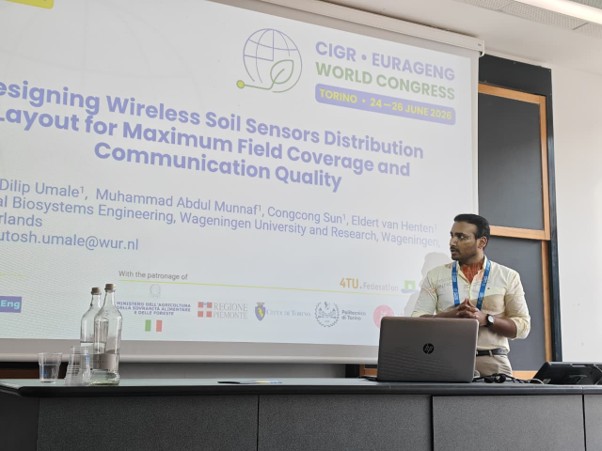
Designing Wireless Soil Sensors Distribution Layout for Maximum Field Coverage and Communication Quality
CIGR EurAgEng 2026, Polytechnic of Turin, Italy, 24-26 June 2026
Ashutosh Dilip Umale; Muhammad Abdul Munnaf; Congcong Sun; Eldert van Henten
Abstract. Precision irrigation requires high-resolution, continuous soil moisture measurements to maximize crop growth and water use efficiency. Wireless soil moisture sensors are widely used nowadays; however, their installation often ignores in-field spatial-temporal variability. This study develops a method for designing wireless sensor network (WSN) distribution layouts for maximum field coverage with a minimum number of sensors while ensuring reliable communication. The proposed approach analyzes Sentinel-2-retrieved normalized difference moisture index as a proxy of soil water, followed by variogram modeling to estimate the effective range, which defines the maximum sensor-to-sensor distance. Sensor locations are then determined using a variogram-constrained clustering algorithm. In a case study over a 26-ha field in the Netherlands, this method distributes eight sensors, achieving approximately 80% spatial coverage. The effective range varies from 23 m to 161 m at mature and early potato growth stages, respectively, indicating the necessity for dynamic adjustment of sensor distribution layouts throughout the growing season. EU868 propagation simulations show that WSN achieves packet delivery ratios above 90% under fully grown potato conditions. These results demonstrate that the proposed method is efficient and effective for designing WSN layouts that account for spatial heterogeneity while ensuring reliable data communication.
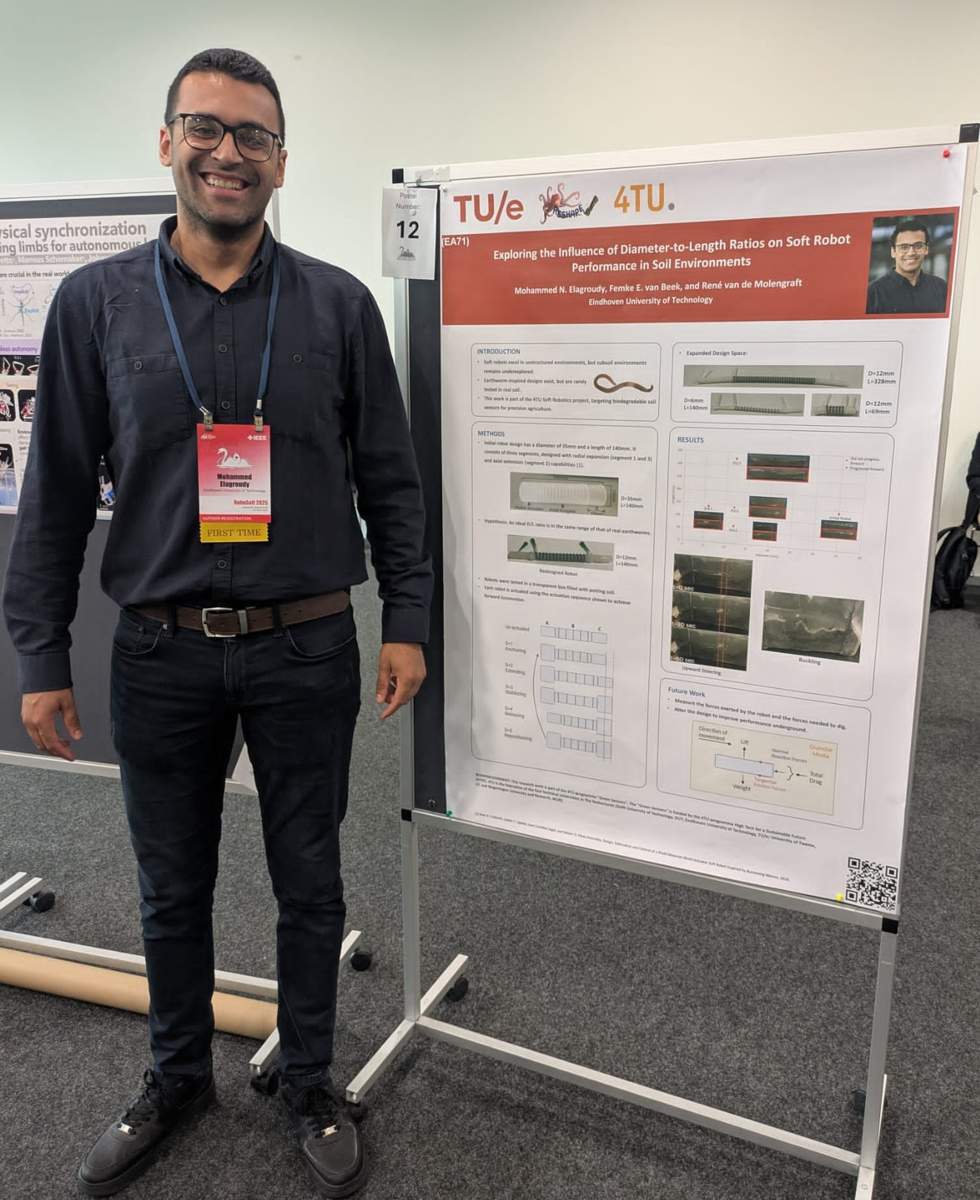
Mohammed Nagy Elagroudy
Exploring the Influence of Diameter-to-Length Ratios on Soft Robot Performance in Soil Environments
Conference: Robosoft 2025, Lausanne, Switzerland
Mohammed N. Elagroudy, Femke E. van Beek, and René van de Molengraft
Abstract:
Precision agriculture requires a thorough understanding of soil conditions, including subsoil characteristics, to optimize crop production effectively. Soft robotics holds large promises for precision agriculture, as it has the potential to overcome challenges associated with subsoil exploration, including precision maneuvering, and minimal soil disturbance. While literature presents many soft robots inspired by earthworms, none of them are tested in actual soil. We fill this gap in literature by testing prototypes in real soil conditions. By designing prototypes with different diameter-to-length ratios, this research shows the impact of these ratios on robot performance in challenging soil conditions, with implications for future agricultural applications.

Vijaykumaran
Microwave-based multifunctional soil moisture sensing for smart and sustainable agriculture
Zsombor Szarka, Vijaykumaran Alagarsamy, André B.J. Kokkeler, Sujith Raman
Radio Systems Group, University of Twente, The Netherlands
Abstract :
This work presents an integrated antenna system for microwave sensing and communication in agricultural applications. The system comprises a proximity-fed Split Ring Resonator (SRR) on one side for sensing and an aperture-coupled Circularly Polarized Antenna (CPA) with beam-switching for communication on the other side.