



What if we could swap heavy concrete bridges with nature-based alternatives? This Eindhoven University of Technology-led EU project ‘Smart Circular Bridge’ (SCB) builds on earlier experiments from October 2016 when students from TU/e, TU Delft, Avans University of Applied Sciences and local vocational colleges in Eindhoven built the world’s first bio-composite footbridge on the TU/e campus: the Biobased Bridge. To read about this previous project you can click the button below.
After 2016 the project continued and built three more city bridges for pedestrians and cyclists in Germany and the Netherlands. A consortium of 15 partners – five universities, seven innovative companies, and three municipalities – makes these bridges possible.
The project aims to develop and demonstrate new approaches to the use of bio-composite materials. Its goals include degradation modeling of bio-composites through accelerated material degradation tests by using a Structural Health Monitoring system (SHM). This detects material degradation and makes real-time calculation of remaining service life of infrastructures, using Artificial Intelligence (AI) algorithms.
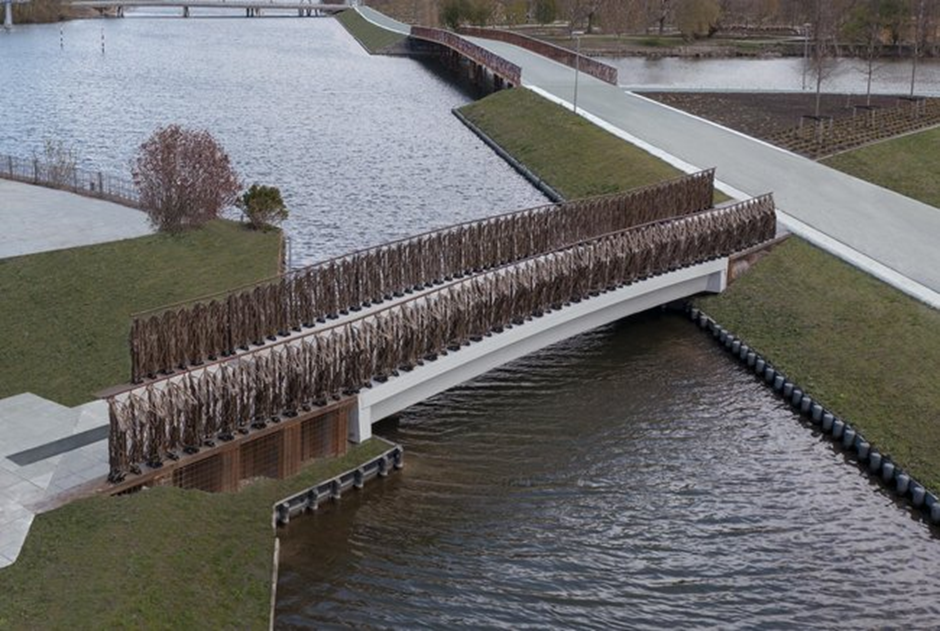
Contribution to circular economy
The construction industry needs to make a transition from extensive fossil materials toward more sustainable and resource-efficient materials and use. However, reliable alternative solutions are lacking. Dutch municipalities maintain over 12.000 pedestrian and cyclist bridges, of which 41% are in a (very) poor condition. Germany shows similar figures. Within the North-West Europe region 0.5 % replacement per year of just these bridges, equals to 95.000 tons of primary raw materials each year.
Bio-composites made from fast growing plants such as flax and hemp offer promising solutions. The plants store CO2 during growth, have strong fibres and can grow nearly everywhere under any condition. These characteristics reduce emissions and mitigate climate impact when used as construction material.
Flax is a material that has been used for millennia in clothing, sacks, and lines for ships. Nowadays, this old material has been ‘rediscovered’ and could become the building material of the future. The Smart Circular Bridge demonstrates the technical feasibility of flax-based fibers and bio-resin composites – lightweight, highly stable materials with mechanical properties comparable to aluminium or light steel. The SCB aims to close material cycles and significantly reduce the environmental footprint of bridge construction.
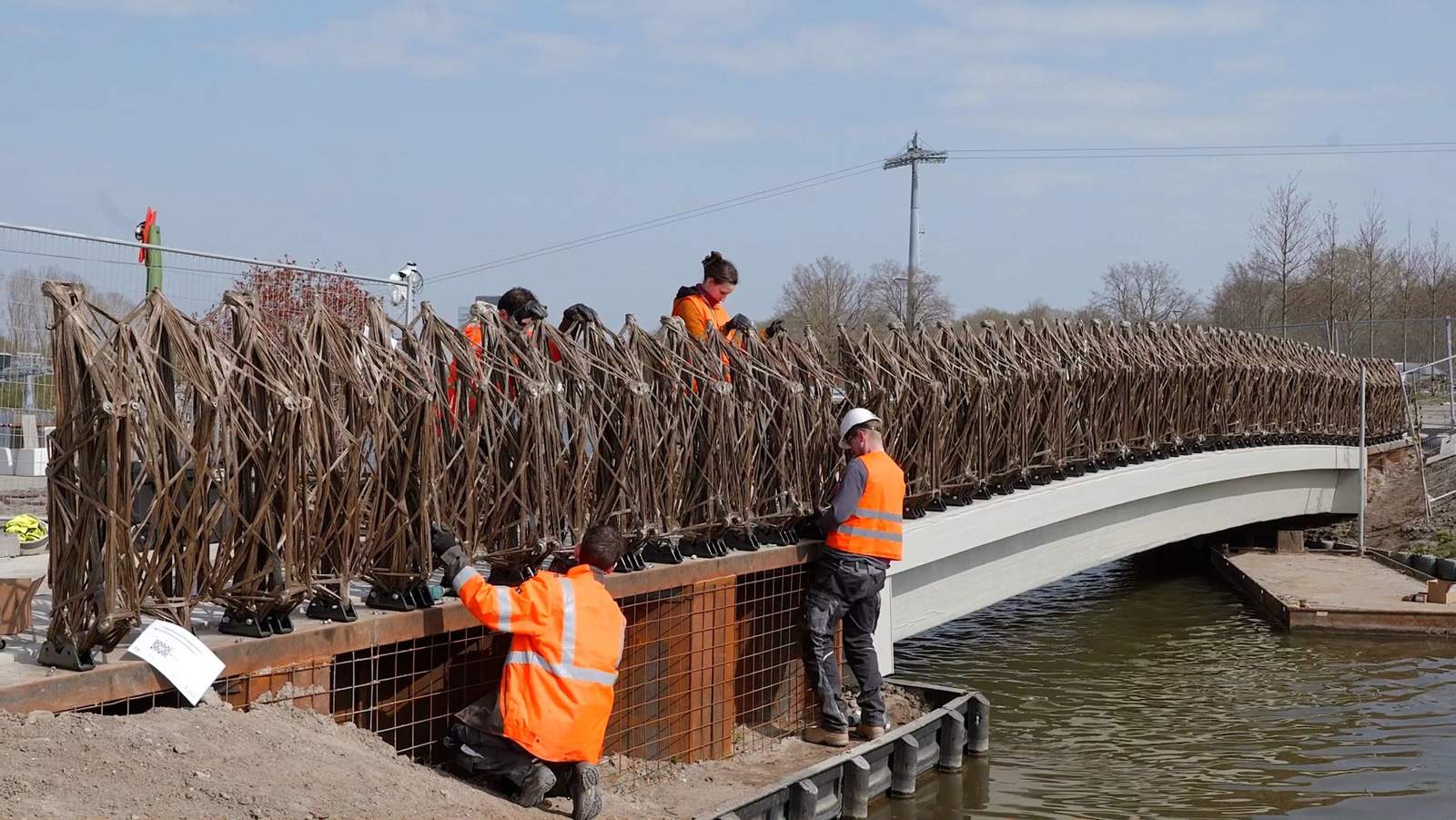
The EU strategy towards sustainable materials
The EU Bio-Economy Strategy (EC. 2018) stresses the need to shift toward natural, renewable materials. Despite an increasing market demand, the construction sector remains hesitant to implement new natural material applications. A key challenge is their material properties, specifically the limited understanding of time-dependent degradation in natural composites, which makes it difficult to guarantee long-term structural safety.
Modern research offers new opportunities
Advances in sensor technology and AI-driven analysis now make it possible to better understand and predict performance of construction materials. By equipping bridge components with sensors, engineers can continuously track how materials and components behave under real-world conditions – an approach also known as Structural Health Monitoring (SHM).
Within the Smart Circular Bridge project, the embedded sensor system evaluates real-time data to detect early sign of degradation and predict remaining service life. This makes it possible to perform maintenance or replace components in time before structural safety is compromised.
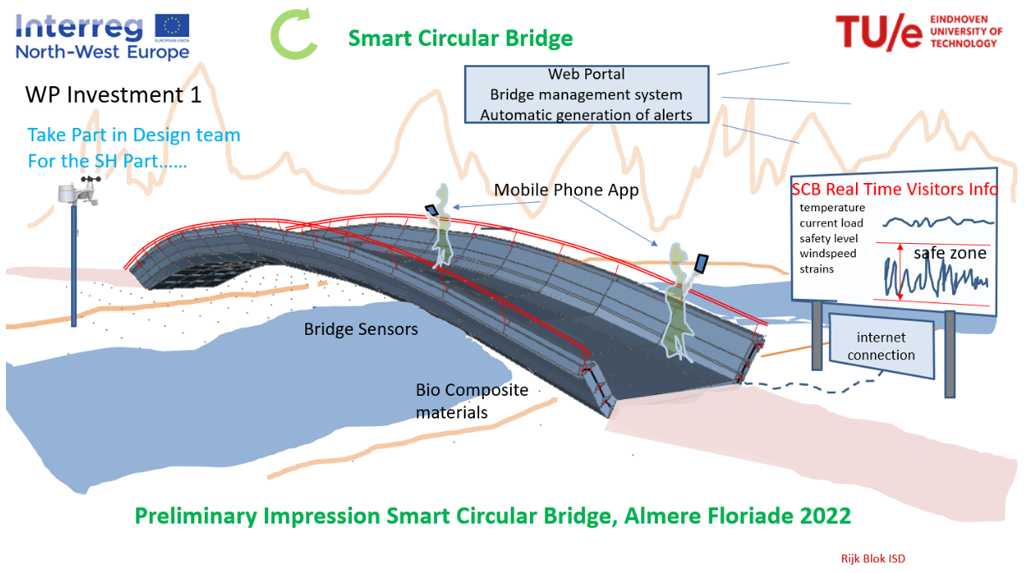
The Smart Circular Bridge project is about much more than bridge construction alone. It serves as a powerful example of how innovation can drive climate protection and the circular economy. By combining innovative biomaterials with smart monitoring systems, the project accelerates a reliable pathway toward circular, resource-efficient infrastructure in Europe. It demonstrates how collaboration between science, industry, and municipalities can turn sustainable ideas into real world infrastructural designs.
Partners:
- Eindhoven University of Technology
ir. Rijk Blok, Prof. Dr.-Ing. Patrick Teuffel - KU Leuven
- FiberCore Europe BV
- 24SEA BVBA
- Com&Sens
- Van Hattum en Blankevoort BV
- Lineo, Groupe NatUp fibers (ehem. Ecotechnilin)
- Universiteit Stuttgart
- Center of Expertise Biobased Economy MNEXT (Stichting Avans)
- Vrije Universiteit Brüssel
- Gemeente Bergen op Zoom
- Gemeente Almere
- Proesler Kommunikation
- Stadt Ulm
- FibR GmbH
Images: Dezeen, 2022