



More and more opportunities for robots on construction sites
The construction industry is exploring robots as a way to reduce the workload. How do we move from theory to practice? A scientist and an entrepreneur share their insights.
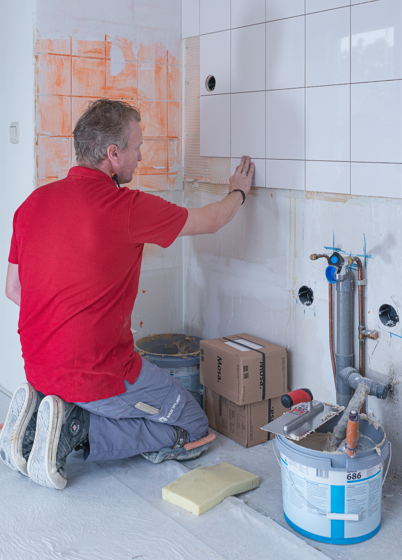
Photo: Van Wijnen
The tile-laying robot
The company is currently exploring the use of a tile-laying robot. “It sounds simple: a robot sees a tile, picks it up using suction cups, and sticks it to the wall. For humans, these are logical actions, but it’s very difficult to teach a robot to perform this task.”
Implementation and scaling up
For the research and development of the tile-laying robot, Van Wijnen collaborated with Pieter Pauwels, associate professor of the built environment at Eindhoven University of Technology (TU/e), and his team. A joint European grant application for further development of the robot is currently underway. For Van Wijnen, implementation and scaling up are of particular importance. “We need multiple robots to ensure the work process runs smoothly. Their deployment must also be commercially viable,” says Vos.
Combination of technologies
Different technologies to ensure the robots run smoothly are being integrated, and they stem from several scientific research projects. “Within the Faculty of Mechanical Engineering (ME), for example, research has focused on the handling of production lines. How firmly do you grip an object to ensure it doesn’t fall, but also doesn’t break under the pressure? The Faculty of Architecture (BE) has also been conducting extensive research for some time into material properties and real-time feedback for the 3D Concrete Printing (3DCP) robot. We also want to apply such technologies to the tile-laying robot,” says Pauwels. “This involves not only the manipulation of objects but also mobile navigation by robots. Ideally, the robot should also be able to find the correct (and safe) path on a construction site. Using AI and semantic models, we can make the system more autonomous in navigation and operation.”
The robot also has to account for all sorts of additional factors. For example, the tiles often have to be brought upstairs; after all, a bathroom is usually located on the first floor. In addition, the robot must consider the location of pipes, doors, faucets, and other obstacles. “For now, our primary focus is on ensuring that the robot can align and install the entire tile on the wall. That means taking care of the largest and most labor-intensive part of the job. After that, a human tile setter can install the tiles with cutouts and other special features,” explains Vos.
Collaboration between humans and robots
Ultimately, the construction company hopes for effective collaboration between humans and robots to organize the work as efficiently as possible and save labor hours. “We’re still in the research phase. The hypothesis is that we can save up to nearly 14 labor hours per bathroom by using robots,” he says. Only time will tell how this actually plays out on the construction site.
The company also spoke with the tile setters who will ultimately be working with the robot. “They see a particular need for the robot to lay out the tiles in advance. Moreover, some actually find performing the ‘easy’ work to be the most enjoyable part of the project,” says Vos. So some developments and adjustments are still needed to align human and machine expectations.
“However, we certainly see opportunities for this technological development,” he says. The tile-laying robot could offer a solution without affecting revenue. The robot can support tile setters' long-term employability by reducing the physical strain of the work. “The role of humans in the process will change somewhat. More attention will be needed for programming and monitoring the robot.”
Human involvement is important
Pauwels agrees. He foresees that people will continue to play an important role on the construction site, particularly in overseeing the bigger picture and coordinating works. Pauwels: “The robots can perform specific tasks and thus take over part of the work currently done by people. But it’s an illusion to think that a construction site can operate entirely in an autonomous way.” To this day, robots are still essentially very large calculators that receive specific instructions. The robust calculation models they are equipped with allow them to carry out instructions. As the instructions become more complex, the level of automation increases. For creative and ‘intelligent’ tasks, it is still recommended to keep humans in charge.”
More robots on the construction site
In addition to the tile-laying robot, TU/e is pursuing other research projects on using robots in construction. Researchers are working on 3D concrete printing (in collaboration with Van Wijnen, among others), clay prints for facades, and “robotic filament winding” with organic fibers (flax) for sustainable building structures (columns, floors).
To integrate all robotic functions and aspects, TU/e is also participating in a European research project, AM2PM, focused on collaboration between different robots. Pauwels: “It’s a kind of central controller that orchestrates different robots. Each robot has its own task, and through this central control, the system carries out the entire process. This is fundamentally important research that will hopefully, at a later stage, be able to coordinate the interaction between machines on a construction site.”
Van Wijnen is also exploring robots. The company is investigating bricklaying robots and exoskeletons. Vos: “This could help people on construction sites lift heavy objects.”
4TU.Built Environment
Some of the research on robotization and digitization in the construction industry is conducted jointly by the various technical universities in the Netherlands. Pauwels: “Different universities have different specializations. Through collaborations such as 4TU.Built Environment, we share knowledge and exchange experiences. The Open Science and Open Access policies in the Netherlands are also crucial in this regard.” In addition, he sees a role for universities of applied sciences and research universities in educating young people. “Tomorrow’s workers are being trained to work with robots and AI. In this way, scientific knowledge and innovation must flow into the market.”
Human contact remains crucial
Pauwels concludes: “Innovations can certainly make a difference in the construction industry, but they won’t immediately solve the major labor shortage. People who have worked in this sector for a long time and are now approaching retirement age hold a great deal of knowledge. I don’t think we can easily capture that digitally, even though we sometimes try. There must also be room for people to pass on knowledge to one another. Human contact remains very important. In this regard, it is crucial that the expertise of experienced workers continues to be passed on to newcomers and doesn’t just end up in a database or a robot.”
Team working on 3D printing robots
Department of Built Environment (TU/e)
Marta Gil Perez, filament winding robot,
Rob Wolfs, 3D Concrete Printing
Ekaterina Petrova, for AM2PM orchestration
Department of Mechanical Engineering (TU/e)
Elena Torta, active collaborator